


Director: Damian Lee
15 | 1h 27 min | Action, Sci-Fi
Not to be mistaken with the hugely popular Marvel superhero series Guardians of the Galaxy, or indeed Cannon Films mega-flop Masters of the Universe, Damian Lee’s sci-fi action film falls way short of its silly, somewhat icky concept and bold titular statement, yet does so in a fashion that is so spectacularly bad you may be eager to revisit at some point in the future, though the stars will probably have to align in your own personal galaxy for you to pull the trigger a second time. Unless, of course, you’re a glutton for crappy, low-grade nonsense that manages to be simultaneously hilarious and completely devoid of wit. Masters of the Universe failed thanks in large part to its derivative Star Wars aspirations, B-movie purveyors Golan-Globus flying too close to the Hollywood sun, but in terms of complete ineptitude in delivering a competent, coherent slice of cinema, this one is in a galaxy far, far away from anything that Cannon produced.
This is somewhat ironic since the movie barely ventures away from a section of woodland that is shot from every angle possible in order to provide the illusion of a much vaster location, the never-ending (though probably filmed close to a bus stop) battleground for a seemingly endless tête-à-tête between two instantly recognizable muscle heads who are way past their 80s prime, a period when superior scripts, production values and star power often presented the illusion of competence. The 90s was on the whole slicker, if more derivative in the action stakes, concepts like Die Hard done to death in movies like Under Siege (Die Hard on a boat), Passenger 57 (Die Hard on a Plane) and Speed (Die Hard on a bus). The increased use of CGI also made affairs feel more contemporary, movies like Terminator 2: Judgment Day wowing audiences with SFX that signaled the dawn of a new era. Abraxas: Guardian of the Universe clearly didn’t get the memo.
Former World Wrestling Federation icon and future governor of Minnesota Jesse ‘The Body’ Ventura and action movie stalwart Sven-Ole Thorsen would once again see better days, starring alongside Sylvester Stallone and Steven Seagal later that decade, but their promotion from bit-part players to screen-hogging headliners just doesn’t work out as the director may have expected. They’re both beyond terrible in ways that will either leave you reaching for the stop button or marvelling, semi-catatonic, at the quickfire (though often meandering) drivel served up in a pungent, steaming hot fashion. It’s a giant, clumsy mess of painfully outlined pseudo-concepts that smack you in the face with such insouciance that it barely registers. It’s probably for the best.
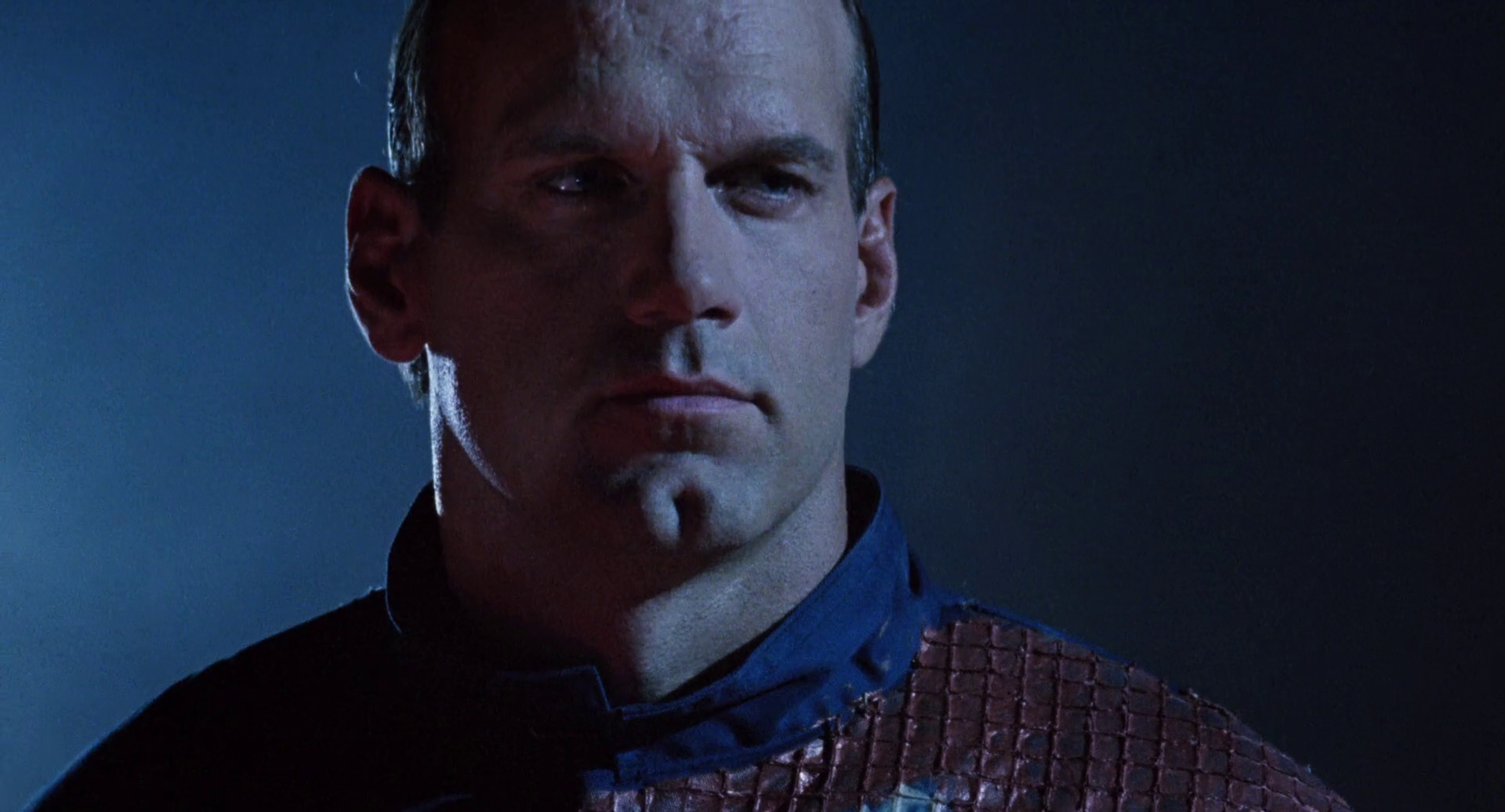
Ventura and Thorsen both had quite the run in the late 80s-early 90s. You may remember them from former Starsky and Hutch star Paul Michael Glaser’s cartoon take on Stephen King’s dystopian novel The Running Man, though John McTiernan’s franchise-spinning Predator (also starring Thorsen), and later Sly Stallone’s attempt at going toe-to-toe with the sci-fi rich Arnold Schwarzenegger, Demolition Man, are Ventura’s two biggest silver screen outings. Without the international celebrity of Wrestlemania to fall back on, Thorsen was typically lower down the card, though with 75 screen credits to his name and a CV that includes roles in blockbuster hits such as Conan the Barbarian, Red Sonja, Lethal Weapon, Red Heat, Twins, Ghostbusters II, The Hunt For the Red October, Total Recall, Terminator 2: Judgment Day, Death Becomes Her, Bram Stoker’s Dracula and Heat, to name but a few, his career is not to be sniffed at. Being a fellow bodybuilding buff and lifelong friend of Arnie obviously didn’t hurt. He was in pretty much everything the actor starred in.
Thorsen and Arnie share much in common when it comes to onscreen ability. Thorsen lacks the inimitable charm, awesome presence and general watchability of his close ally, but the similarities to Schwarzenegger, at least during those rocky early years, are palpable. As a star attraction, Thorsen takes wooden to a whole new stratosphere, bumbling his way through scene after scene with the grace of a grumpy old caveman with a severe migraine. The Danish strongman’s accent is even more of a distraction, plunging Arnie’s early Teutonic troubles to barely decipherable depths. In movies like The Terminator, the likes of James Cameron had enough sense to limit Arnie’s dialogue, relying more on his sheer physical presence. Thorsen has no such luck. In a movie packed with expositional narration from all sides, the lines tumble from his lips like boulders careening over the cliffside of some bottomless canyon. He makes Zangief of Street Fighter fame seem intelligible by comparison.
Surprisingly, Ventura doesn’t fair much better. Technically, Thorsen is the more experienced of the two, but with most of his roles consisting of bit parts and stuntman duties, you’d have to give the edge to Ventura. He was such a huge personality in the 1980s; colourful, vibrant and immensely watchable, one of the figureheads of a ‘Rock n Roll Wrestling’ era that saw the old territorial system usurped by the bright lights of international exposure. Not that you’d know it if you’d only saw him in this movie. Despite his larger than life persona and alpha male tendencies, the kind that continuously landed him in the bad books of fallen business magnate and sports entertainment tyrant Vince McMahon, who soured on Ventura for attempting to forge a union for exploited wrestlers, he is almost bereft of star power here, coming across as muted and somewhat subdued – a far cry from his hyperbolic turns as The Running Man‘s Captain Freedom and Predator‘s macho badass Blain.

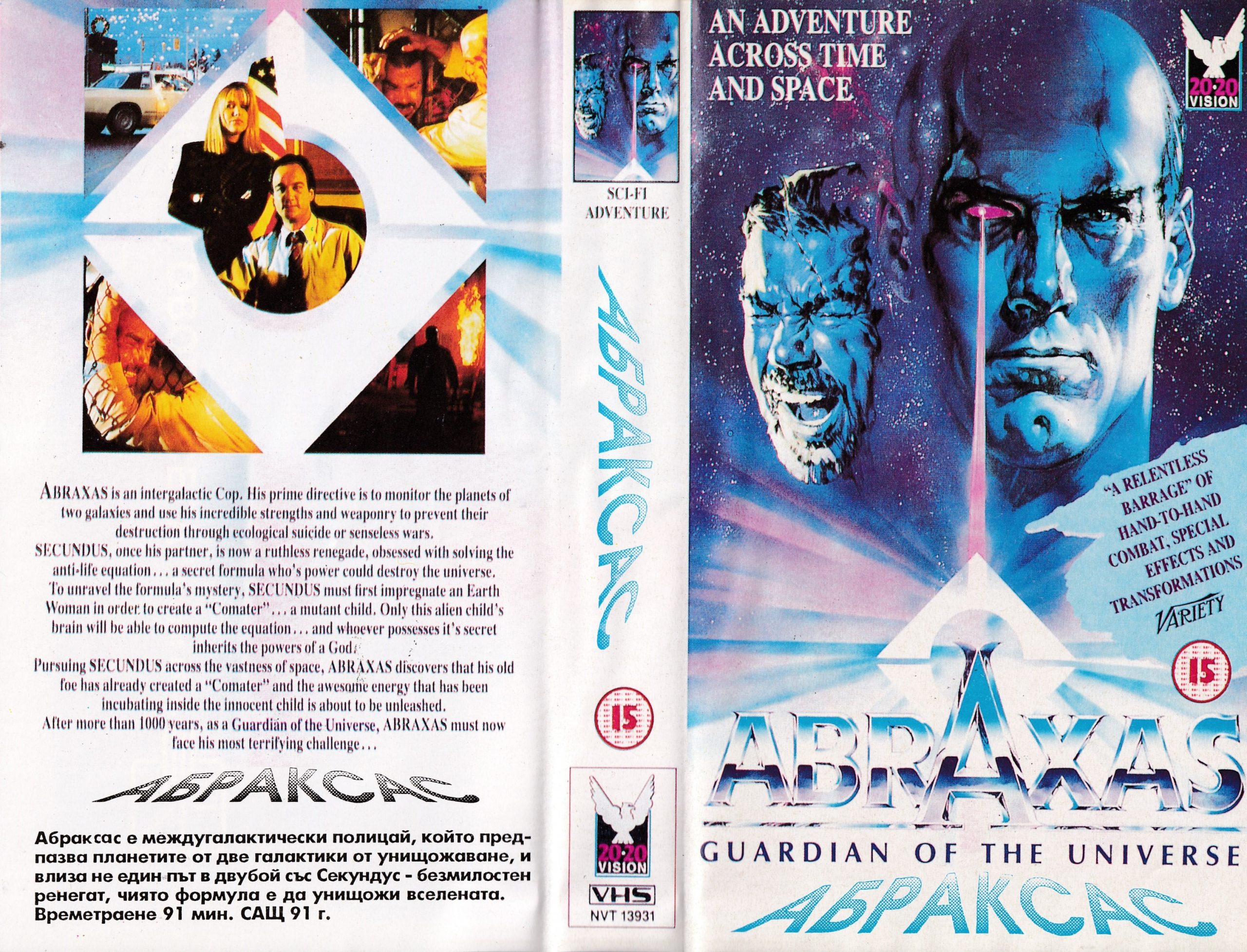
All the ingredients are there for an over the top adventure with giant personalities, but there’s no getting away from the low production values and general incompetence of Abraxas: Guardian of the Universe, which makes terrestrial TV fodder like Knightrider and Magnum PI seem like Emmy worthy works of art. The film would be right at home sandwiched between Baywatch and MacGyver during a Saturday afternoon re-run marathon. Ventura plays the eponymous Abraxas, an extraterrestrial cop on the trail of a rogue ex-partner with designs on fucking things up on an intergalactic scale, though with Ventura’s big, bumbling dickslap as its guardian, you begin to suspect that the universe probably doesn’t stand a chance. That’s until ex-comrade and megalomaniac defector Secundus (Thorsen) shows up, proving himself just as inept as the action unfolds in a way that is both confusingly frenetic and queerly laboured.
For such a bad dude, Secundus is selective when it comes to offing the various extras who get in his way or simply pick fights with a soap opera convenience that borders on the derisory. Everyone seems to have a problem with the colossal stranger who can crush a person’s skull with such ferocity that they evaporate into thin air courtesy of special effects that the makers of Quantum Leap would have rejected outright. It’s all so unnatural. Such interactions generally occur after some random accidentally stumbles upon Secundus’ quest for absolute power, confronting him for trespassing, acting suspiciously or simply breathing the same air. Those who pose no real obstacle die horribly, while two armed cops, completely at his mercy, are nonsensically spared to continue in their pursuit of him.
It doesn’t take long to establish our villain’s nefarious intentions. After some painfully obvious model work introduces us to an outpost on our alien protagonist’s home planet – an exposition express that, much like the movie’s laughable bouts of stilted narration, fills in the many curious blanks with a relentlessness that will leave your brain frazzled – we discover that Secundus has designs on raping and impregnating “a birthing member of the human race” with the purpose of triggering an “anti-life equation”, which his son may or may not have the power to compute, and which Secundus is capable of “ripping right out of his brain”. If that sounds confusing, welcome to the club, and it won’t be the last time you’re left scratching your head. The screenplay for Abraxas: Guardian of the Universe is somehow both skeleton-thin and hopelessly convoluted. The cod-science on offer is absolutely off the charts to the extent that it will just go in one ear and out of the other.

The movie’s chosen one, the virgin Mary if you will, is Marjorie Bransfield’s Sonia Murray, who is brutally cast away by her conservative parents and rejected by civil servants who not so subtly brand her as a shameful whore who is unworthy of their support (they should really stop hiring far-right Christians). Not one of them thinks to question how she managed to go through an entire pregnancy and have a baby within a single day, though if an unplanned child is enough for total rejection, stories of extraterrestrial villains with the power to impregnate simply by hovering their hand above a woman’s belly probably would not have gone down too well, and as for a pregnancy that results in a fully formed baby mere minutes after conception… well, the family exorcist probably has enough on their plate.
Fast-forward five years and calling on the family exorcist may not be such a bad idea after all. Yet another expository bout of narration, this time from Sonia, who treats the movie’s silly events like an epic novel, reveals that the newly christened Thomas aka the Culmator is something of an odd card, an enigmatic mute who harbours suspicious, unidentifiable thoughts beneath his playful, childlike demeanour. Sonia is plagued by further fears regarding the future of her immaculately conceived son, admitting, “I don’t know why, but I have this feeling that something will take him away from me forever.” Whatever could have given her that idea?
Abraxas was wisely ordered to kill Sonia before the child was born, but being such a swell, grossly negligent guardian of the universe, and given the extreme timeframe that alien births allow, he can’t bring himself to do it in time, resulting in an absolutely improbable romance that is delivered with all the grace of a Secundas-made baby. After a brief spell on the prison planet Tyrannus 7, Secundus inevitably returns to Earth to claim his prize. In the world of make-believe, his odds of success are slim, but with the bumbling Abraxas as our only potential saviour, a gambling man could be forgiven for chancing an outside bet.
Take Five (Thousand)
Music is so important to movies. Imagine Blade Runner without Vangelis, Beverly Hills Cop‘s Axel Foley without Harold Faltermeyer’s character galvanising hit Axel F. Imagine 99 percent of movies without the appropriate audio accompaniment. Chosen wisely, music makes every facet of a movie that much more engaging. You can’t really have one without the other.
Abraxas: Guardian of the Universe definitely falls in that abysmal one percent category. The film’s music cues, mostly ripped from Blade Runner, only add to the film’s silliness. There’s nothing wrong with the music per se. It’s competent enough. It’s just that the story is so ludicrous, the acting so melodramatic, you just can’t take it seriously, like the moment in which a lost and lonely Sonia looks out over a not-so-spectacular snowy landscape against a longing, neo-noir sax piece, or the scene in which Abraxas and Secundus clumsily brawl to full-on sex jazz. It’s almost beyond comprehension.
Quack Shot
For such a nefarious brute, Secundus is a bit of a softie, particularly when it comes to the cops – you know, the only people with weapons who have even a remote chance of taking him down. Maybe I’m missing something, but not putting them out of commission when the chance arises seems like a misguided choice for someone with such monumental plans.
Not that disarming them and holding them at gunpoint would have guaranteed anything as Secundus proves himself a horrible shot, shooting at and somehow missing a passing motorcyclist at point blank range in a moment that is so unconvincing it should probably have been scrapped entirely.
Built to Last
As female lead Sonia Murray, the truly abysmal Marjorie Bransfield only adds to the astonishing ineptitude that is Abraxas: Guardian of the Universe. How on earth did she ever land a role in anything?
Why nepotism, obviously.
Murray was briefly married to 80s hotshot James Belushi, who appears in a cameo role as the concerned headmaster of Thomas’ school. Between 1986 and 1991, she appeared in 5 other movies starring Belushi: About Last Night…, Red Heat, K-9, Homer and Eddie, and Taking Care of Business.
Teacher’s Pet
You may not believe it given Belushi’s relative acting pedigree in a cheapjack movie like Abraxas: Guardian of the Universe, but the scene that he shares with his then wife is arguably the most laughable in the entire film, but part of the reason can be attributed to the atrocious dialogue on offer.
Exhibit A involves a dull-witted conversation between the two involving the behaviour of son Thomas:
Latimer: [The other kids] act out. They push him. They call him names. They tease him. Constantly.
Sonia: Why don’t you tell them to stop teasing him, to stop pushing him, to stop calling him all kinds of names? Have you ever thought of just telling them to stop it?
Latimer: (Deep in thought) No. No I haven’t.
Despite featuring two stars who might be considered action movie royalty, with a dash of Jim Belushi thrown in for good measure,
Edison Smithis a laughably incompetent, ludicrously performed hunk of cod science-fiction that stumbles, fumbles and rambles its way to bad movie immortality. Just don’t expect a sequel.











 vhsrevival.com