


Director: Tony Maylam
18 | 1h 31min | Horror, Slasher |
If you’re looking for an archetypal, non-franchise slasher, then look no further, because The Burning has it all. In fact, Tony Maylam’s low-budget slice-and-dicer has all the prerequisites for a successful horror franchise: a horribly disfigured killer, an iconic weapon, and the kind of by-the-numbers revenge story that would allow the likes of Jason Voorhees an entire decade of commercial decadence. The Burning never forged its own franchise ― perhaps a blessing in disguise given its stature as one of the most popular non-franchise slashers ― but it very well could have for reasons beyond those already mentioned.
The Burning was Hollywood tyrant Harvey Weinstein’s first punt at movie making. This was long before he was able to use his power to exploit the desperately ambitious, but Hollywood success was what he craved, and the low-risk slasher flick was the perfect entry point following a career as a rock concert producer alongside business partner Corky Burger. So fundamental was he to getting the picture made that, as well as producing, he was responsible for devising the movie’s story, the origins of which making for some rather uncomfortable reading, particularly given the nature of his own indiscretions. Not only is the tale of Cropsy based on a real-life urban legend, that legend would one day become something of a reality.

Many kids had heard the legend of Cropsy long before he made it to the silver screen. Though details are hard to come by, Cropsy (spelled Cropsey) was the subject of many a campfire tale for kids in and around New Jersey and upstate New York during the mid 1970s. Like most urban legends, the story was passed around for decades and embellished beyond recognition. The most common rendition tells the story of an escaped mental patient with a hook for a hand who wandered the tunnels beneath the infamous Willowbrook State School, a real-life institution accused of advocating physical and sexual abuse during the 1960s and beyond. It was a tale often repeated by camp councillors, a deterrent for kids who would go off wandering in the woods after dark.
As documented in the 2009 film Cropsey, it was during the late 1980s that those whispers became national news. Between 1978 and 1987, five children would disappear from Staten Island, the main suspect being former Willowbrook custodian and loner Andre Rand, who at the time was homeless and living on a makeshift campsite on the abandoned school. The disappearance of the last of those children, a 12-year-old Downs Syndrome girl named Jennifer Schweiger, would spark a mass community search in and around the woods surrounding the area, and would coincide with Willowbrook’s eventual closing in the fall of 1987.
The following year, Andre Rand was charged with the kidnapping and first-degree murder of Jennifer Schweiger. Though there was insufficient evidence to convict Rand on the murder charge, he was sentenced to 25 years for first degree kidnapping, many detectives believing the murders were tied to Satanism at a time when the US was wrapped-up in the infamous ‘Satanic Panic’, a moral hysteria that turned ordinary citizens into devil-worshipping demons and religious fanatics into something not too dissimilar. It is worth noting that Rand is a suspect in at least three other missing persons cases.

When The Burning was released back in 1981, those real-life revelations were a half-decade away, but the Cropsey legend had long-been established, the movie, along with 1982’s similar summer camp slasher Madman, inspiring its own variation on the Staten Island monster. In the film, Cropsy is a summer camp caretaker who wreaks bloody vengeance after a misguided prank leaves him heavily scarred from first degree burns. Cropsy is portrayed as an alcoholic and implied paedophile, but the details of his legend are barely explored. What we get instead is a by-the-numbers genre picture that embodies the golden age of slasher cinema with grisly aplomb.
One thing that immediately strikes you about the movie, at least in hindsight, is the incredible wealth of acting talent on display. Slashers are notorious for their atrocious levels of acting, and for the most part The Burning is no different, but the majority of Cropsy’s targets would go on to forge rather notable onscreen careers. Perhaps most notable is Seinfeld‘s Jason Alexander, who basically plays a younger variation of George Costanza, a witty and mildly cynical joker in the pack who may as well be auditioning for his most famous role. There’s also a brief appearance from ‘Elastigirl’ herself, Holly Hunter, The Player’s Leah Ayres, Hollywood bit-part stalwart Larry Joshua (Dances With Wolves, Unforgiven), 80s support player Brian Backer (The Money Pit, Fast Times at Ridgemont High), Hollywood regular Fisher Stevens (The Grand Budapest Hotel, Hail, Caesar!) and talented TV regular Ned Eisenberg (The Sopranos, Law and Order). This in itself makes The Burning a curious watch almost four decades after its release.
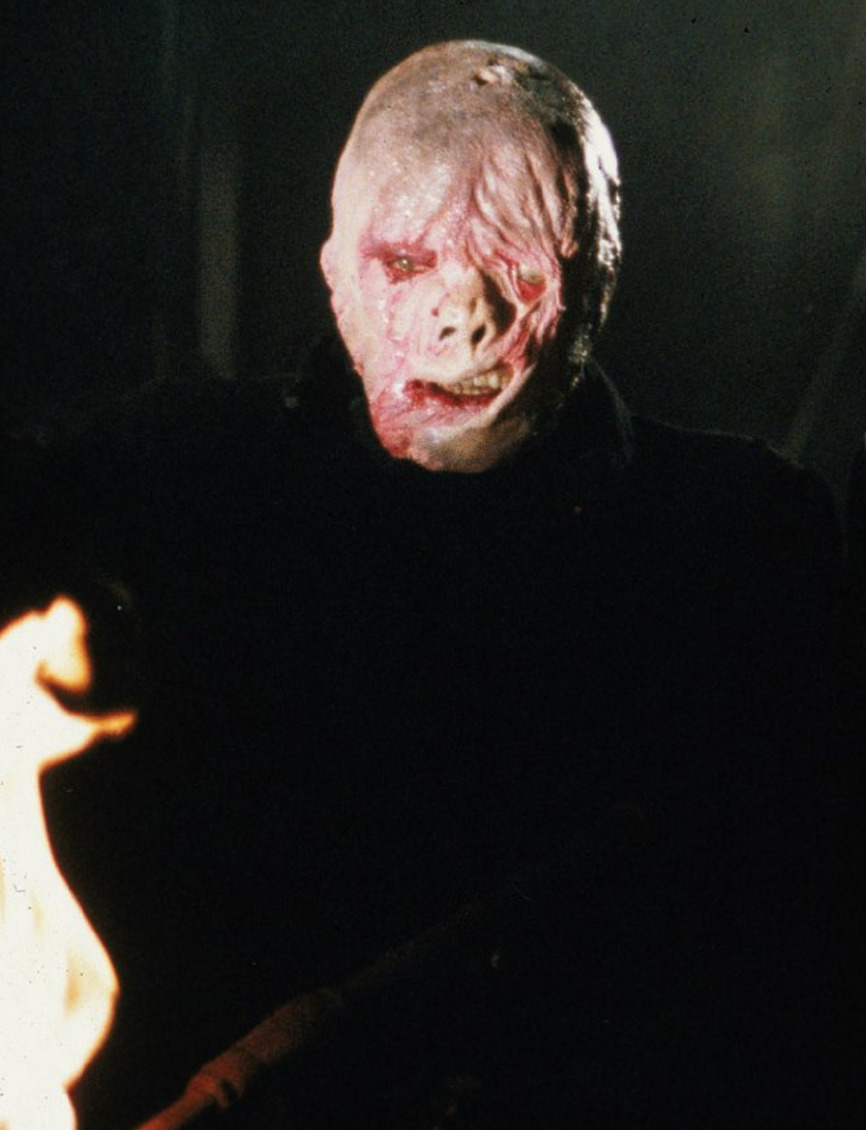
As for the movie itself, you won’t find any real surprises here. For one thing, The Burning‘s setting is the most familiar in the entire genre: a Crystal Lake clone situated across the river from the now abandoned Camp Blackfoot, the site where the fictional Cropsy legend was born. After the aforementioned prank gone awry, curmudgeon Cropsy is admitted to a special burns unit and eventually released by a doctor who warns his patient that, in light of the severity of his injuries, it may take some time for him to integrate himself back into society, a proclamation that will leave you in hysterics once you finally lay eyes on our novice gardener’s grizzled visage.

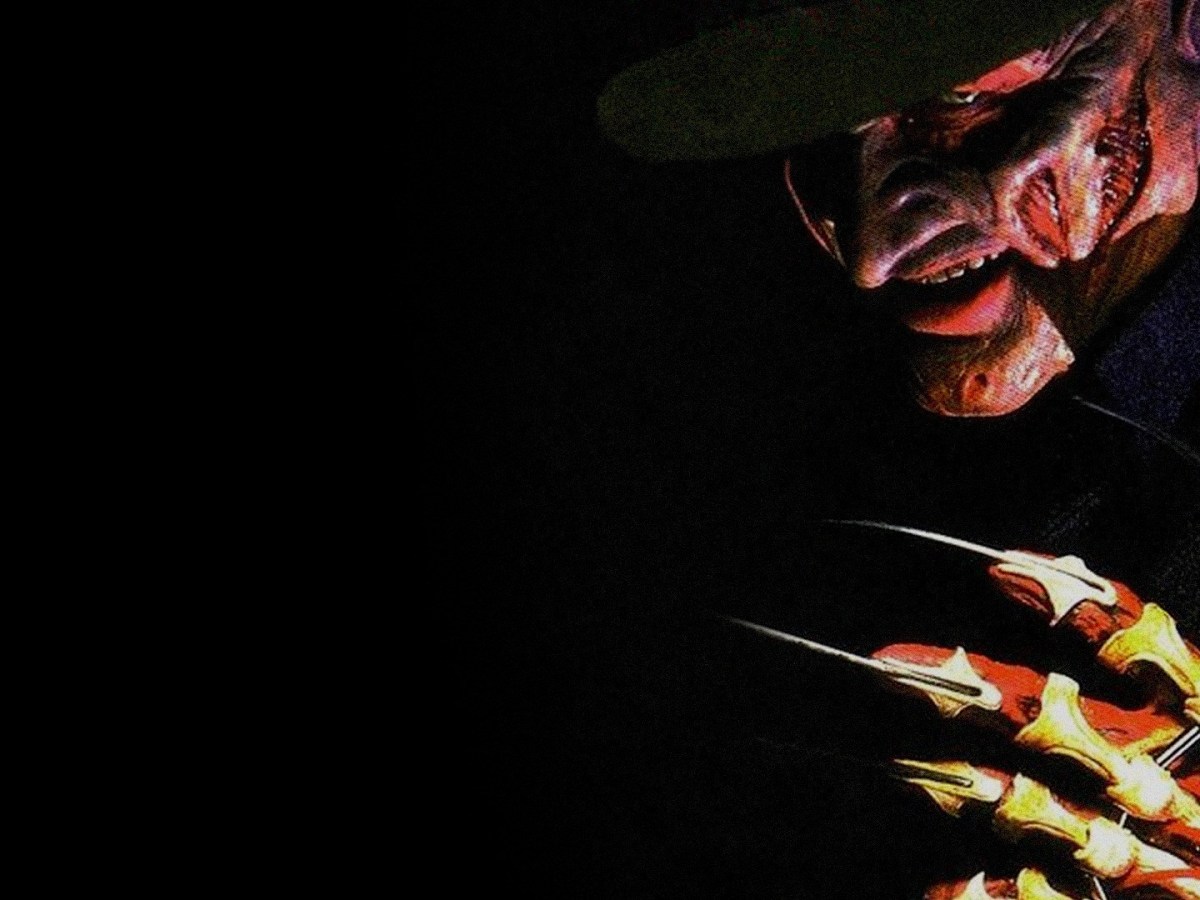
Our killer’s look is a little underwhelming when you compare him to the likes of Fred Krueger, practical effects maestro Tom Savini having little more than four days to deliver a design for the movie, but make no mistake about it, The Burning is all about arguably the most famous practical effects hand in the entire genre, whose twisted eye for carnage, a skill acquired while serving as a photographer in the Vietnam War, achieves perfect harmony with Rick Wakeman’s gut-wrenchingly desolate score and an aura of nihilism that soaks you to the bone. Dubious masks aside, Savini delivers some of his most outstanding work, particularly for the infamous canoe massacre, an abrupt banquet of hacked temples and chopped fingers that still shocks almost half a century after the movie’s release.
The effectiveness of one of the sub-genre’s most infamous scenes is further heightened by The Burning‘s ability to paint an authentic picture of camp life. Don’t get me wrong, the screenplay is ludicrously formulaic and seeped in melodrama thanks to its low production values, but it at least takes the time to build a sense of community, to the extent where the pacing can seem just a little laboured as our cast stroll through a first act where a POV presence dallies on the periphery. Ultimately, we care enough about the film’s naïve and jovial cast. None of them deserve to die, even the movie’s token bully, Glazer, who has a heart of gold beneath his tough guy exterior, making him perfect fodder for a movie that (eventually) piles on the death and destruction.
Despite its by-the-numbers adherence to slasher convention at a time when the sub-genre was entering the early stages of oversaturation, The Burning has a disconcerting atmosphere that was lacking in the majority of shake and bake productions looking to strike while the commercial iron was particularly hot. It’s all so grainy and hopeless, a haze of inevitable reckoning hanging over events like a misty morning river. Cropsy cuts an intimidating figure too, his shear-wielding agent of death all cloak and daggers, a striking silhouette against a tired haze of beleaguered sunlight. There’s hardly any pause for respite as the action unfolds. It can be truly oppressive at times.
It certainly helps that The Burning, in its full, uncut glory, features some of the most realistic practical effects kills that the sub-genre has to offer, with an emphasis on physical destruction that displays Savini’s more sadistic side, each sequence approached with the morbid zest of an infant vampire let loose on the world’s largest blood bank. In a post-hippy environment of Reagan’s family values, the film’s young cast are absolutely savaged for their pubescent urges, a grim reflection of a society that actively discouraged the personal freedoms of previous decades.
Not that audiences got to see The Burning in its full, untamed glory. The film’s US theatrical release was hastily cut by 45 seconds by the Motion Picture Association of America (MPAA) in order for the film to receive an ‘R’ rating. This included gore shots that were miserably shortened or simply deleted altogether, depriving the film of much of its shock factor. A grisly scissor attack on a prostitute was sabotaged significantly, as were various other shots deemed unsuitable for audiences back in 1981, negating the film’s power almost completely. The UK theatrical release suffered a similar fate, but for those lucky enough to get their hands on a rather special copy during its limited time on rental shelves, there was a precious silver lining.
Prior to The Burning‘s outright banning at the hands of the British Board of Film Classification (BBFC), a move that would lead to the confiscation of all tapes under the Obscene Publications Act of 1984, VHS distributor Thorn EMI would accidentally release the movie in its full, uncut form. Whether this was an actual mistake or an act of savvy marketing has never been determined, but it certainly didn’t end well for the company, their efforts to release a BBFC-approved version proving futile (though I imagine a fair few copies wound up on the black market). Whatever the case, the incident only served to raise the profile of one of the sub-genre’s most talked about entries, an uncut version of which failing to see the light of day until 2007 when MGM released a beautiful 1:85:1 Widescreen transfer. Copies of that original, pre-certificate release are now among the most sought after for VHS collectors.
Blind Date
The Burning‘s gruesome gallery of deaths are a joy to behold for slasher fans. Though the finger-chopping, temple-slashing canoe scene is easily the stand-out moment, as a standalone kill we have to go back to the movie’s inaugural slaying, one redolent of pre-certificate slashers in their ugly, golden age glory.
After being stupid enough to take a ludicrously incognito Cropsy back to her rented room for some paid-for rumpus, a sleazy street whore is somehow surprised to find a deformed and sinister monster lurking beneath. The scene is quite the anomaly, almost jarring in the context of the whole film, but the kill itself is slasher filmmaking at its most delightfully cynical.
The moment when a pair of scissors pierce the victim’s exposed abdomen was the other scene deemed too obscene by the BBFC, and almost rivals the frenetic canoe slaughter for sheer gratuitousness.
Safety First
In the ludicrous realms of cruel slasher pranks, there’s contrived, there’s ridiculous, and then there’s The Burning.
Having been crudely awoken and terrified beyond comprehension by the crummiest prank imaginable, caretaker Cropsy somehow contrives to set himself on fire, an incident made all the worse by a dubiously placed canister of petrol that sets his shed ablaze and sends him flailing into the wilderness.
Choice Dialogue
Before being introduced to the flesh horrors of a freshly burned Cropsy, a medical intern (heavily balding and clearly too old to begin medical school) is prepped by a hospital orderly in desperate need of some workplace etiquette.
Orderly: After you see this guy, you’ll never want to come back in here again. Man, this guy is so burned, he’s cooked! A fucking Big Mac, overdone! You know what I mean? And it’s a miracle that he’s still alive. If it was me, I’d prefer to be dead. No way I’d want to be this freak. He’s a monster, man! I’ve been working here 10 years and I’m telling you, I’ve never seen anything like this.
Despite the iconic, shear-wielding silhouette that punctuates each brutal attack, Cropsy will never rank with the genre’s most recognised killers, but as a symbol of slasher ignominy there are few that can match
Edison Smith, a monument to the genre’s golden age that will light a campfire under your dead-eyed spirit.






 vhsrevival.com