


Tom Cruise thrills in Michael Mann’s sprawling study of the disassociated city
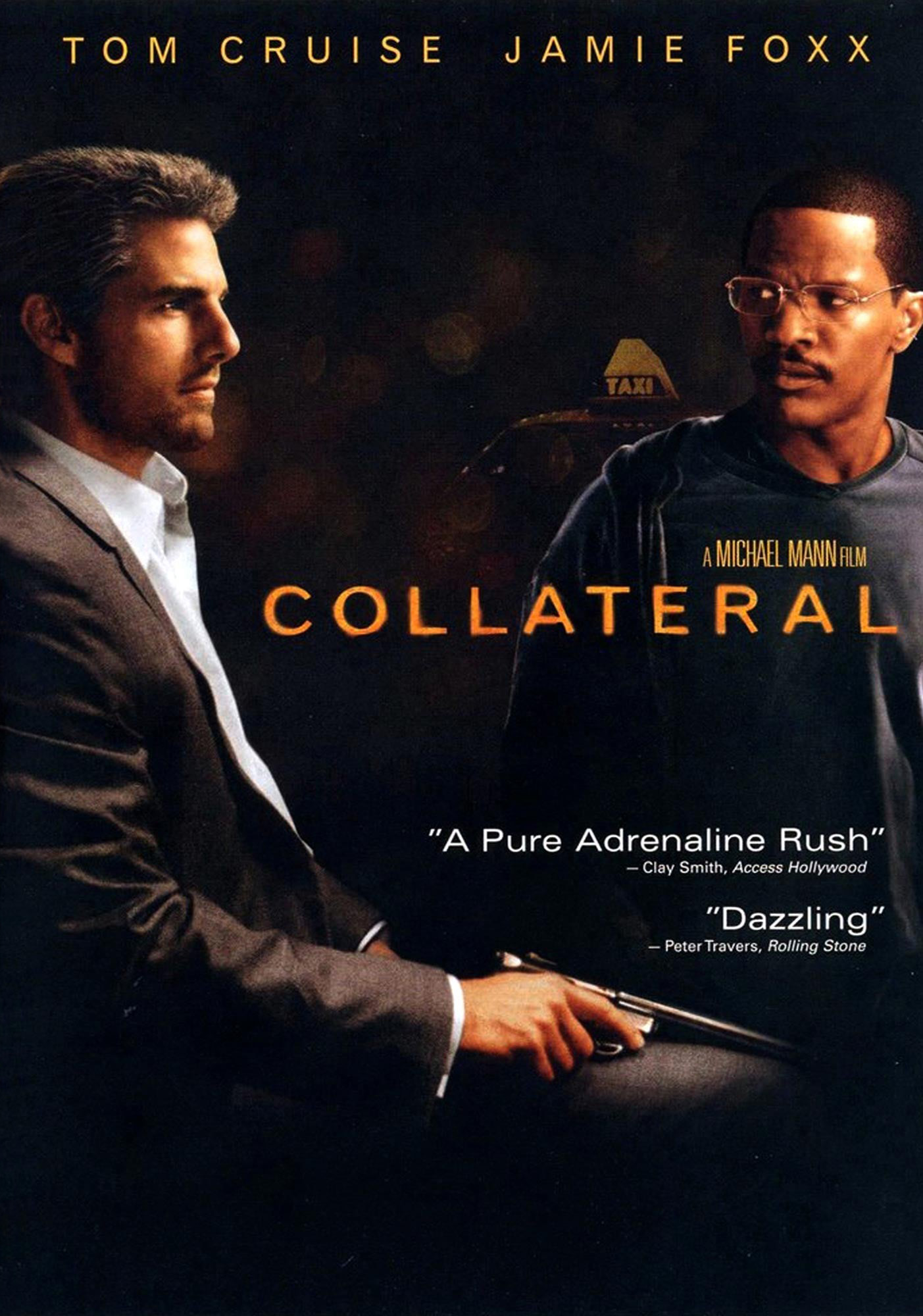
Collateral is a dysfunctional take on a dysfunctional sub-genre, a buddy movie in which our mismatched duo, brought together and torn apart by fateful events, careen towards an inevitable confrontation. Tom Cruise’s dead-eyed assassin and Jamie Foxx’s mild-mannered cabbie are never friends in the traditional sense, but there are times when they depend on each other entirely, a dynamic that blurs the margins just enough to keep us second guessing and rooting for both characters as a unit. It makes for one hell of a compelling thriller.
All the best buddy movies thrive on their sense of conflict. Walter Hill’s 48hrs. opposed black and white, the left hand of the law and blue-collared criminality. Richard Donner’s Lethal Weapon gave us another black and white pairing, only this time race took a backseat to emotional catharsis, Mel Gibson’s undomesticated animal tamed by Danny Glover’s traditional family man. Collateral also uses the sub-genre’s most convenient aesthetic delineator, but this isn’t your average odd couple. The fact that our duo’s journey, bound to and motivated by various conditions and developments, evolves over the course of a few hours, makes for a relationship that is more complex and less predictable. “I wanted to compress time, to imagine the psychological extremes when two lives collide unexpectedly,” Mann would explain while discussing his approach to filming within a compressed, linear timeframe using only a few key locations. “Small [details] become very important when, for example, you don’t change wardrobe, when the time of day doesn’t change, when the colour of night or the cut of a suit becomes crucial.”
Collateral was first conceived by screenwriter Stuart Beattie when he was just 17. Beattie, who was taking a cab home from Sydney airport, became lost in thought as as the driver, a complete stranger, glibly chatted away as if they were long-time friends. It struck him as odd that this man would trust not only him, but dozens of other random passengers every single week for much of his working life. Of all the people who had ridden in the back of his cab at one time or another, how many were violent or unhinged? How many were straight-up murderers? How many were serial killers, people who killed everyone and anyone, no questions asked, people who killed for a profession? Hour after hour the driver, and many more like him, would pick up passengers on a whim, unconcerned by who they might be or what they might be capable of. It was a scary thought, and the ideal set-up for a neo-noir thriller based on survival, suspicion and second-guessing.

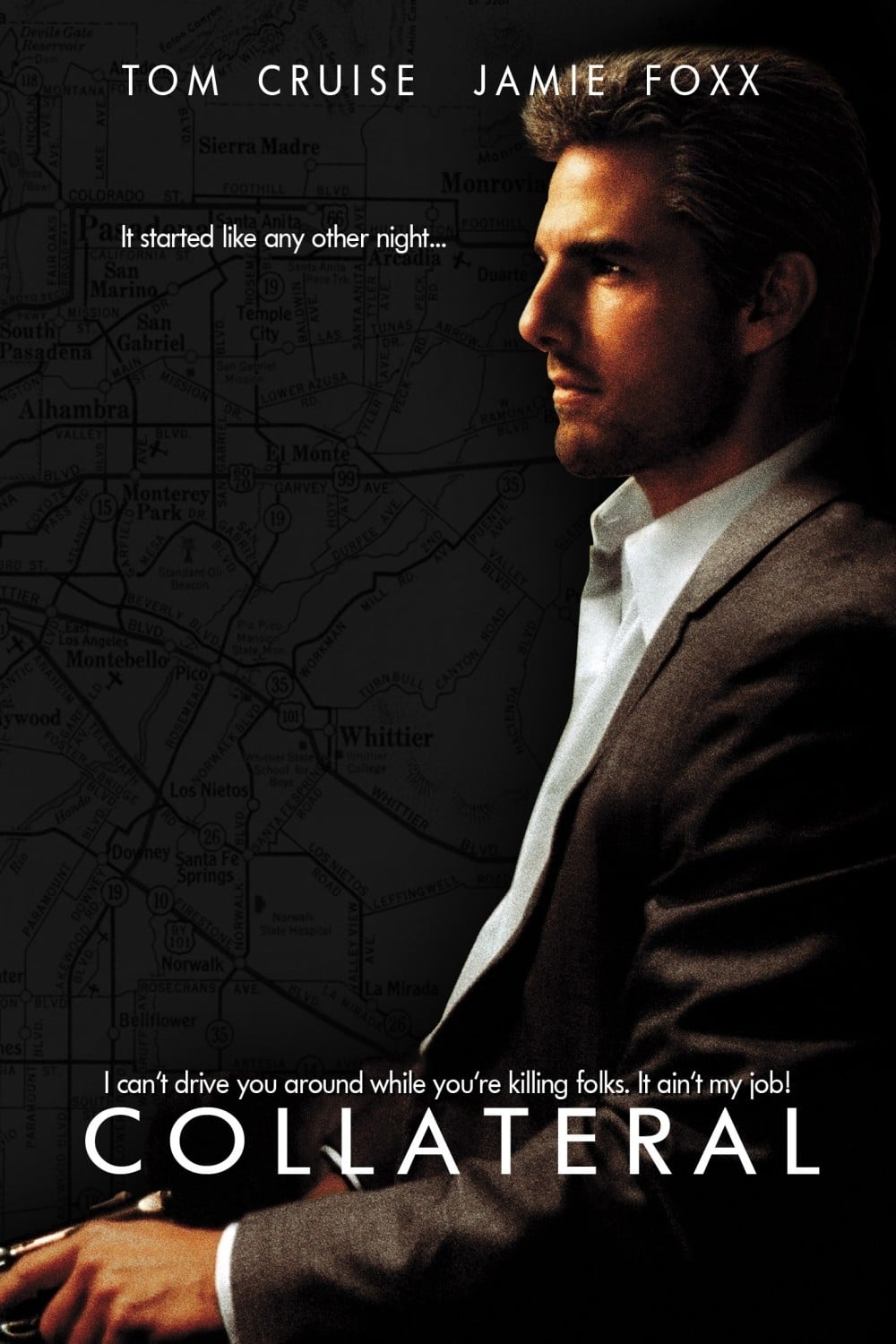
Early in the film, Vincent (Cruise) arrives in LA for undisclosed reasons. After hailing a cab he immediately endears himself to meticulous driver Max (Foxx), making the kind of small talk that in reality is a series of calculated questions designed to acquire information about a person who will soon become vital to his undisclosed mission. Vincent is a master manipulator, a coach and motivator skilled in the art of justification who ties his unwilling accomplice in existential knots. He talks candidly about his distaste for the city and its apparent disconnection from human understanding. He tells the story of a man who died on a subway train, only to remain undetected by his fellow passengers for hours on end. After charming Max into a contracted fare, Vincent kills his first of many targets, calmly emerging from the building and routinely handling the physical and emotional mess that the murder results in. Max’s decision to not immediately flee the scene is a rational choice based on the character’s distinct lack of bravery, the very reason he continues to stumble half-heartedly towards the seemingly unattainable pipe dream of running his own chauffeur business. The fact that he stays the course instead speaks to his quasi-captor’s uncanny powers of persuasion.
Tell you the truth, whenever I’m here, I can’t wait to leave. It’s too sprawled out, disconnected.
Vincent
It’s clear from the off that Vincent is something of a contradiction, his erratic behaviour a mechanism for maintaining control over any given situation. This is a man who flips between murder and empathy with an insouciance that defies reason, but with his skewed logic and misplaced philosophies he is able to come across as relatable, his actions strangely justifiable. When Max freaks out upon realising the reality of his situation, Vincent is somehow able to put things into perspective. After all, why care about the demise of one bad guy when innocents die in Rwanda every single day? Is one person’s life more valuable than thousands more? A spurious justification for murder, but a relevant one, and a stark reminder of the hypocrisy of the human condition.
Vincent is a different breed of antihero in the sense that we can never quite figure him out. His act isn’t filtered by subtlety. We’re not completely fooled as we are with a character like James Gandolfini’s Tony Soprano. His contradictions are immediately obvious, are in fact flagrant, and he seems at peace with his decisions and the socially undesirable role he inhabits. A spiritual, passionate, empathetic assassin, he is the personification of pretentiousness, an advocate for the modern, disconnected society that he so openly decries.

Is there any truth to anything Vincent says while on the charm offensive? If the truth is convenient at a particular moment, then probably. Like all great villains of the sociopathic persuasion, it’s sometimes difficult to gauge exactly who or what we’re dealing with, and to what end. But one thing is certain: the job comes first, everyone who needs eliminating will be eliminated, and in a profession where witnesses are detrimental, you have to believe that Max, despite living up to the film’s title, and despite a relationship with genuinely endearing moments, will ultimately be added to that list. Vincent is a meticulous, emotional chameleon dictated to by a singular goal. He may carry a gun along with his briefcase, but in many ways he is the embodiment of the ruthless corporate metropolis which acts as a backdrop to his unflinching game of non-discriminatory assassination, Max the powerless everyman squirming beneath. He’s all business.
This sense of detachment is familiar to director Michael Mann, who in the exceptional Heat painted a portrait of two moral opposites plunged into a world of emotional disengagement. Here he shoots the city in much the same way, immersing us in devastatingly aloof birds-eye shots of a billion-footed beast of frenetic and ceaseless action. This is mostly thanks to cinematographer Dion Beebe, who replaced BAFTA winner Paul Cameron three weeks into filming due to creative differences. Collateral was actually the first major motion picture to utilise Viper FilmStream High-Definition Camera technology, which could replay takes immediately after they were shot, allowing Mann to reshoot on the fly. This meant lower costs, fewer time restraints and a frenetic process in-keeping with the movie’s compressed time concept. There are other Mann hallmarks which hammer the point home in terms of composition — the unsettling framing of the film’s characters and intimate, often claustrophobic close-ups that jerk and meld from one subject to the next — but in Collateral the director seems to go one step further, reducing an entire narrative strand to a pawn in his game of large-scale anonymity.
Like most crime thrillers, we follow the exploits of two cops who inevitably become embroiled in events, but unlike the majority of those movies, theirs is a peripheral involvement which takes up a third of the film’s running time without having any real tangible impact on proceedings. Weidner and Fanning, played by the suitably detached Mark Ruffalo and Peter Berg, respectively, are on the punitive trail as a series of related witnesses fall thick and fast. The pair seem tired and lethargic, singed of all emotion as they track the usual cast of morbid victims scattered across LA’s savage streets, an environment where homicide is as inevitable as their morning coffee. The two are so anonymous and lacking in motivation or backstory they saunter through the movie like shadows on the neon-drenched fringes. Their roles as protagonists are never truly delineated. They’re simply two spectators to the city’s marauding parade. When Fanning is abruptly disposed of in the second act his demise is of little consequence. He and Weidner appear to have no discernible human connection beyond professional duty.

The one truly authentic bond that exists in the movie (asides from the one Max shares with his demanding mother — yet more collateral for Vincent’s crafty endeavours) is that of Max and Annie (Jada Pinkett Smith), who in the ultimate irony are fated by an unlikely contrivance. In Collateral, characters cross with happenstance on several occasions — Annie and Vincent on parallel escalators, Vincent, Max and Fanning in a hospital elevator — but Max and Annie share the only relationship which doesn’t act as a reminder that in the modern, sprawling metropolis, people are everywhere and nowhere. The two are not exempt from the city’s alienating nature. Max is a lonely momma’s boy with fading dreams of success, Annie a high-flying professional hiding behind a mask of inhuman strength — the kind of person who immerses herself in isolated, late-night workloads as a way to escape the reality of her existence. In the end, it is a shared predicament that brings the two of them together, the defence mechanisms they’ve created manifesting in different personalities of a complimentary nature.
Sure… he’s depressed so he jumps four stories out of a window onto his head.
Fanning
The only other relationship that shows any hint of a human connection is that of our two central characters. Though their relationship is one of co-dependency that either would destroy given the right motivations, there are moments of comedy that alleviate affairs and endear us to Max and Vincent as a buddy pairing, giving us just enough rope to hang ourselves with. When Max is robbed at gunpoint by a gang of opportunistic thugs, an emerging Vincent puts out their lights with a fearsome display of coldblooded professionalism. He merely wants the briefcase that contains the information he needs to finish the job, but as an audience we embrace him as our protagonist’s saviour. The same can be said when Max’s exploitative boss threatens to dock his pay for damage incurred to his cab. Once again Vincent takes control of the situation, calling out his boss’s bullshit and threatening legal action. Max’s life may be in Vincent’s hands, but there are occasions when that isn’t necessarily a bad thing.
The movie’s highlight comes when the tables are suddenly turned. After visiting his sick mother in hospital at Vincent’s request, a thinly-veiled threat masquerading as congeniality, our downtrodden stooge is overcome by a reckless surge of determination, fleeing the building and tossing his captor’s briefcase off a bridge in the hope of ending the job and saving lives. You have to admire Max’s show of courage and determination, however reckless and poorly thought out, but in reality he’s put himself in the firing line, and if he’s to survive the night he’ll have to further develop those characteristics rather significantly, rather quickly.

The kind of people who pay to have a series of witnesses assassinated in a single night are naturally short on patience, and since a usually impeccable Vincent may be walking the proverbial plank by humbly visiting his employer’s big city nightclub with the news that he’s jeopardized the whole job, he forces Max to impersonate him and request a back-up disc of his remaining targets, his mother’s welfare being the bargaining chip. Foxx is exceptional as the faux-assassin forced into the Lion’s Den, his meek façade crumbling under a masterful turn of hard-ass deception that puts the power back in Vincent’s hands, but also Max’s.
Throughout the movie, Vincent pushes Max to stand up for himself, encouraging him to confront his boss, to call the hotshot lawyer who took an unexpected liking to him and finally take control of his life. It’s all a ruse on Vincent’s part, a way to endear himself to Max, to manufacture common ground for the good of the job, but his self-serving motivations work a little too well to the point that the whole game backfires. If he can get Max to come out of his shell, he’ll make a better, more motivated accomplice, but in the end Vincent instills too much fight, too much confidence, and when Annie is revealed as his final target, all bets are off. Max’s oppressor has finally made a man out of him.
Is Vincent, a man who clearly has very little understanding of the reality of human relationships, actually fond of Max? If his ravings about the tragedy of human disengagement hold any semblance of truth, then perhaps the good-natured Max is the antithesis of his skewed perceptions, the one soul in his life who is actually worthy of being spared. The movie’s standoff on a subway train as Vincent pursues Max and his final target raises further doubts. When Vincent realises he’s dying, he doesn’t take the chance to put a bullet in Max, instead choosing to die peacefully in the presence of his one-time ally. There almost seems to be a sense of respect there, a quiet understanding as the two share a peculiar moment.
More likely this is wishful thinking on my part, which speaks to the movie’s power of deception. Earlier, when the two slip off to a jazz bar, it seems reasonable that they’d share a drink. They’ve been through quite the ordeal together, and as an audience we desperately want to like Vincent, especially when he begins to show what seems like genuine passion for the musicians on stage, but when a seemingly innocuous whiskey turns into something else entirely, we quickly realise that we’ve been suckered in all over again.
Did you join Amnesty International, Oxfam, Save the Whales, Greenpeace, or something? No. I off one fat Angelino and you throw a hissy fit.
Vincent
Like the film’s audience, Max becomes an unknowing pawn in an assassin’s game, and the con never ends it seems. As a jazz enthusiast, Vincent gives the man a way out, a trivia challenge in exchange for his life. The man answers confidently but dies anyway. Did he get the question wrong as his killer so boldly claims? Does Vincent even like jazz? Cruise gives such a convincing performance that it’s impossible to know anything for certain.

Russell Crowe, who was originally scheduled to play the role of Vincent, would approach Mann about the possibility of directing Collateral early on, the two maintaining a relationship following their collaboration on The Insider, but after several production setbacks the actor abandoned the project. Mann then approached Cruise, Adam Sandler his first choice for the role of Max, but the latter dropped out due to scheduling conflicts. Amazingly, screenwriter Beattie, who was a huge fan of Taxi Driver, pushed for Robert De Niro in the role of Max, though unsurprisingly the studio were adamant on casting a much younger actor. Oscar winner Cuba Gooding Jr. was also approached but rejected the role for fear of being miscast, which finally opened the doors for Cruise’s eventual co-star, a relative newcomer who exceeded all expectation. On the casting of Foxx, Mann, who had previously worked with the actor on Ali, would say, “I saw that [quality of Tom’s] in Jamie on In Living Color — his characters were so vivid. That’s why I went after him for [cornerman] Bundini Brown in Ali. Jamie starts with mimicry, but then he talks about “putting it into the database,” so he can access a character once he’s got it down”.
Cruise, almost unrecognisable beneath a striking shock of silver, is a revelation as the wildly unpredictable, yet wholly calculated Vincent, grinning like a fox in the headlights as he sleekly slips from one increasingly tight situation to the next. He prowls the suffocating LA streets like King coyote, too slick to arise suspicion and too refined to get caught in the frenzied deluge of human traffic. As a ruthless hitman he certainly looks the part, but Vincent is more than just a coldblooded action villain. He is a learned, strangely passionate character with meaningful opinions, though how much he reveals and why is never less than questionable, something Cruise is able to translate with effortless aplomb. The actor has come under a lot of scrutiny during his long and storied career, most notably for his personal life and a seemingly unquenchable thirst for mainstream attention, but who better to play such a disassociated character than a man who seems to go through high-profile relationships like hot dinners, who purportedly has future spouses auditioned by the Scientology powers that be? In all seriousness, nobody does Hollywood quite like Cruise. He has worked alongside some of the industry’s finest directors and he rarely disappoints. His turn as the inimitable Vincent is no exception.
Discussing the actor’s startling visual transformation, Mann would later explain. “That was an intuitive thing — I saw Tom as all steely, and the visual for that was silver hair and a tight gray suit. The man he’s playing is erudite, well read, and [his] sociopathy is total. With Tom, you don’t get what you hear from a lot of movie stars, which is ”Don’t move me out of my range, what I bring to every movie I do.”
Director: Michael Mann
Screenplay: Stuart Beattie
Music: James Newton Howard
Cinematography: Dion Beebe &
Paul Cameron
Editing: Jim Miller &
Paul Rubell







 vhsrevival.com
Well said about “Collateral”; this is my favorite Tom Cruise role right here. While watching, I imagined how I’d respond if placed in the situation Jamie Foxx’s character Max was in, and that’s one element that really kept me immersed in the proceedings. My favorite scene? The Nightclub scene with the song “Ready Steady Go” (reminds me of the Nightclub scene from 1981’s “Nighthawks”, with Keith Emerson’s “I’m a Man” playing during the showdown between Deke & Wulfgar) playing throughout. I think this film is awesome, one of my favorites of Michael Mann’s (probably second to “Manhunter”).
LikeLike
I’m glad you like this one. I think it’s sorely overlooked and cruelly dismissed by those who perceive it as footnote Mann. It doesn’t have the action scale or emotional conflict of Heat, and Manhunter will always be my favourite of his, but it’s a fine, fine movie — certainly one of my, if not my favourite Cruise performance. Nighthawks! Now there’s a movie I really should revisit!
LikeLiked by 1 person
Yeah, I feel the action is mostly verbal & psychological, and I like that:-). I know “Heat” is a great film, but I find “Collateral” much more re-watchable for me, one of those films I could always have running in the background while I’m doing stuff (back when I had a home to do stuff in, he he), then stop what I’m doing and get absorbed in the story.
I can’t rate it over “Manhunter” either; you know, I’m a little lukewarm on the rest of the Hannibal Lector ( spelled”Lecktor” in “Manhunter”, and how good was Brian Cox there? I felt he was outstanding. Nothing against Anthony Hopkins’ portrayal, but Brain Cox is my go-to Lecktor/Lector) series, although I like “The Silence of the Lambs”. I haven’t re-watched it over and over like I have “Manhunter” though, a film which really captures my imagination.
Oh yeah, “Nighthawks”: I haven’t thought about the film in a few years, but in thinking back to that “Collateral” night club scene, there it was. Certainly worth a revisit, and a film I feel is overlooked a little bit.
LikeLike
Cox is amazing as Lecktor. Hopkins chewed the scenery in the way only he can, but I prefer Cox too. He’s fearsome in a different way. The soundtrack really adds to Manhunter’s woozy, existential horrors, especially Kitaro’s Seiun/Hikari No Sono and Klaus Schulze’s deliciously dark Freeze — an incredible piece of music.
LikeLiked by 1 person
Yeah, I think the music in “Manhunter” is incredible, both instrumental and vocal (where I feel that the film hits that “Miami Vice” nerve the most, especially “Graham’s Theme” just like “Crockett’s Theme”, alike in title at least).
I love the scene in “Manhunter” when Cox’s Lecktor uses the aluminum from the stick of gum to circumvent his phone call privilege to get the goods on Graham; so smooth.
I just realized that there have been two recent VHS Revival reviews, both with Tom Cruise (yeah, the man really wanted to be a movie star, and achieved that; whatever his personal affairs, I think he grew as a performer and brings substance and energy to his portrayals. I can understand, though, why he turns some people off; he did me once as well), both with him playing a character named Vincent!
LikeLike