
VHS Revival takes to the wilderness with a bona fide action icon
Sylvester Stallone’s Hollywood journey, from relentless bit-part player to Oscar-nominated rookie to modern commercial juggernaut, was nothing short of phenomenal. Shooting to superstardom as boyish underdog Rocky Balboa, he would later become one of the most recognisable movie stars on the planet, sculpting his body and onscreen persona to shine as one of action cinema’s most indomitable forces. In the 80s and 90s, that’s where the money was for someone of his profile. Movies such as Cobra, Cliffhanger and Demolition Man thrilled action junkies the world over, the actor possessing an uncanny knack for staying relevant. Schwarzenegger would ultimately usurp him as the action genre entered the sci-fi-infused 90s, but during his mid-80s pomp, Sly was second to none.
Personally, I was always an Arnie kid. Thanks to high-tech, special effects juggernauts such as Paul Verhoeven’s Phillip K. Dick reimagining Total Recall and James Cameron’s Terminator 2: Judgment Day, which was an absolutely monumental event back in 1991, becoming the most expensive film to date in a genre where bigger was often better, the excitement was always a notch higher for Schwarzenegger’s latest release. He just seemed more adaptable and in-tune with the changing times. It didn’t help that Sly went through something of a commercial slump as Arnie’s stock soared to new heights, the triple blow of Rocky V, Oscar and Stop or My Mom Will Shoot!, a movie that his Austrian foe tricked him into starring in, seeing his stock plummet as he looked to reinvent himself.
Stallone’s attempt at reinvention was long overdue, his muscles-to-burn M.O., buoyed by 80s power ballads and sweat-induced montages of gloriously ostentatious proportions, becoming just a little old hat and one-dimensional. In reality, his movies had been losing ground at the box office for some time. He still broke the $100,000,000 mark on a semi-regular basis, but the halcyon days of Rambo: First Blood Part 2 and Rocky IV, movies which raked-in in excess of $300,000,000 each, were a thing of the past.

As I’ve grown older, I’ve developed more of an appreciation for Sly. Arnie will always be the man for reasons that are largely indecipherable, but Stallone seems to offer a little more depth and variation, possessing a boyish charm that makes characters like Balboa so appealing. Arnie got by on sheer presence and a determination to succeed, but Stallone was much more than just an actor. He was a hands-on, all-consuming, movie-making beast. He had some serious acting chops in his arsenal too. How many other action stars have been nominated for both the Best Actor and Original Screenplay Oscars? He may have ditched his aspirations of being a serious actor early on, but he took Hollywood by the balls and refused to let go. Sly confessed to having an ego the size of a Zeppelin at his mainstream apotheosis, and when he began chasing Arnie he in many ways tried to emulate what made his adversary so successful, but Stallone’s finest moments came long before the two would take to the commercial battlefield.
You know, wearing that flag on that jacket, looking the way you do, you’re asking for trouble around here, friend.
Sheriff Teasle
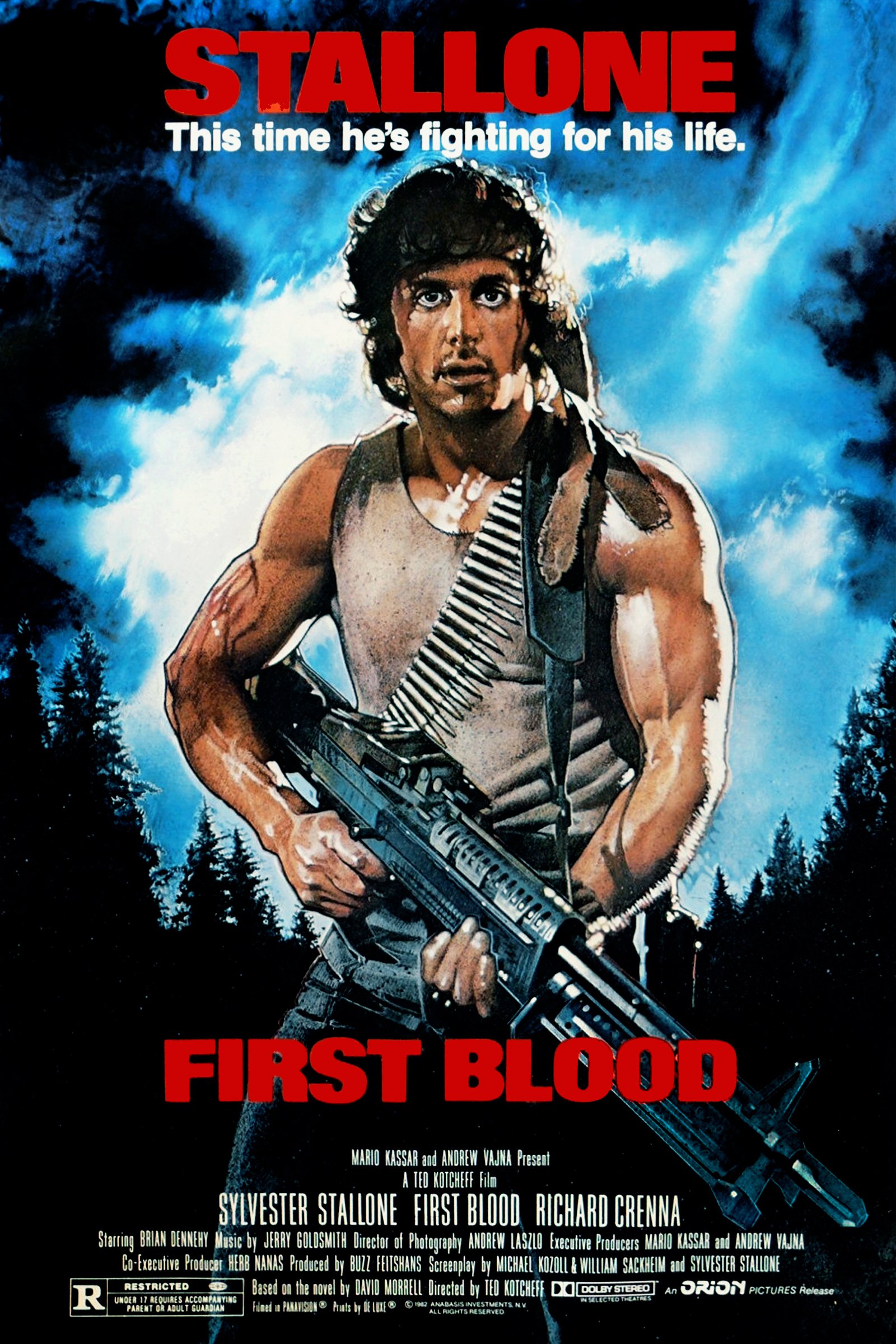
Stallone is most recognisable as two of mainstream cinema’s most famous faces: the aforementioned Rocky Balboa and John Rambo. The latter is an interesting case in point. First Blood would arrive on our screens long before the majority of folk were even aware of Arnie as a mainstream giant, and in many ways Rambo is the original lone warrior, a blueprint for the many Arnie-esque action heroes who would forge war-torn commercial paths of their own. Rambo: First Blood Part II and Rambo III would grow increasingly caricaturistic, giving us a one-man army who would wage commercial warfare with the likes of Arnie’s John Matrix, but before the character descended into the realms of self-parody, subjected to a serious lampooning at the hands of Charlie Sheen’s Topper Harley in spoof sequel Hot Shots Part Deux, Rambo was a much more sombre character offering social commentary on contentious, real-life issues.
First Blood is still an action movie at heart, descending into immoderate territory rather sharply. As a serious Vietnam movie it may be less authentic than some of its contemporaries, but Stallone’s second commercial baby eschews the self-righteousness of the Cold War struggle for the psychological fallout of an unwinnable war. At its repudiated core, the Vietnam conflict was an attack on communism, an ultimately unprofitable war that lingered on for reasons of vanity—an eye-opener for a Civil Rights generation who rejected the myopic patriotism of former conquests and began asking questions of their government and its motives. This led to further conflict at home. On one side you had a generation who clung to nuclear family sentiments as millions of American youths succumbed to the horrors of combat. The US Army had moulded a generation of killers who were sent into the unexplored wilderness to die, the atrocities that they were forced to commit turning many into deeply afflicted citizens who were unable to integrate back into society. They were unappreciated by the young and quickly forgotten by their government. They had sacrificed everything in return for nothing.

These are the issues tackled in First Blood, and tackled well during the movie’s first act. A Stallone vehicle was never going to have the emotional power of The Deer Hunter or the sobering punch of Full Metal Jacket, and the movie is very much of its time rather than timeless, but it was relatively ambitious for a mainstream action vehicle, particularly as it challenged the attitudes of people who would make up a good portion of its target audience. Granted, First Blood adopts a more crowd-pleasing formula than its literary source material, the ending of which would have shut the door on the film’s inevitable sequels, but the movie is a refreshing diversion in that it at least acknowledges the uglier, less polemical side of war, and the suburban horrors, namely distrust and prejudice, festering beneath the patriotic veneer of small-town life. While other action movies championed the American Dream, First Blood was the first to feature a cinematic super soldier who had declared war on his own country. For a mainstream action vehicle it was anarchic stuff.
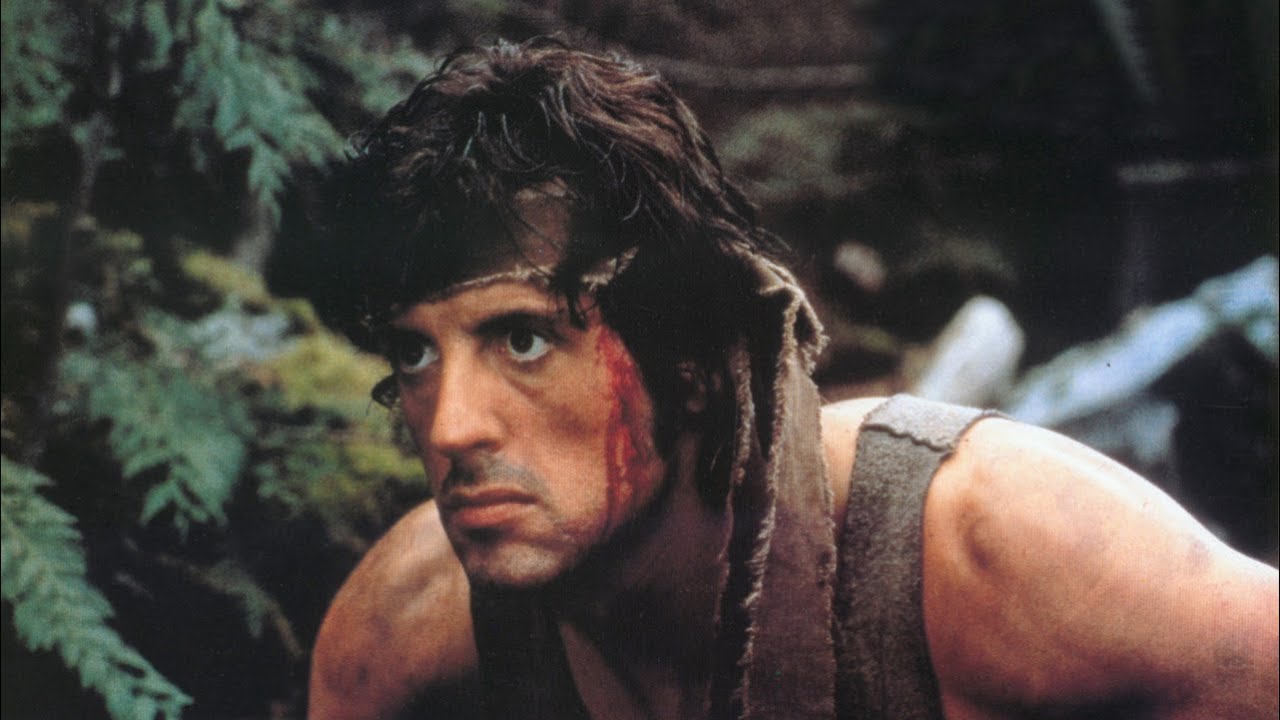
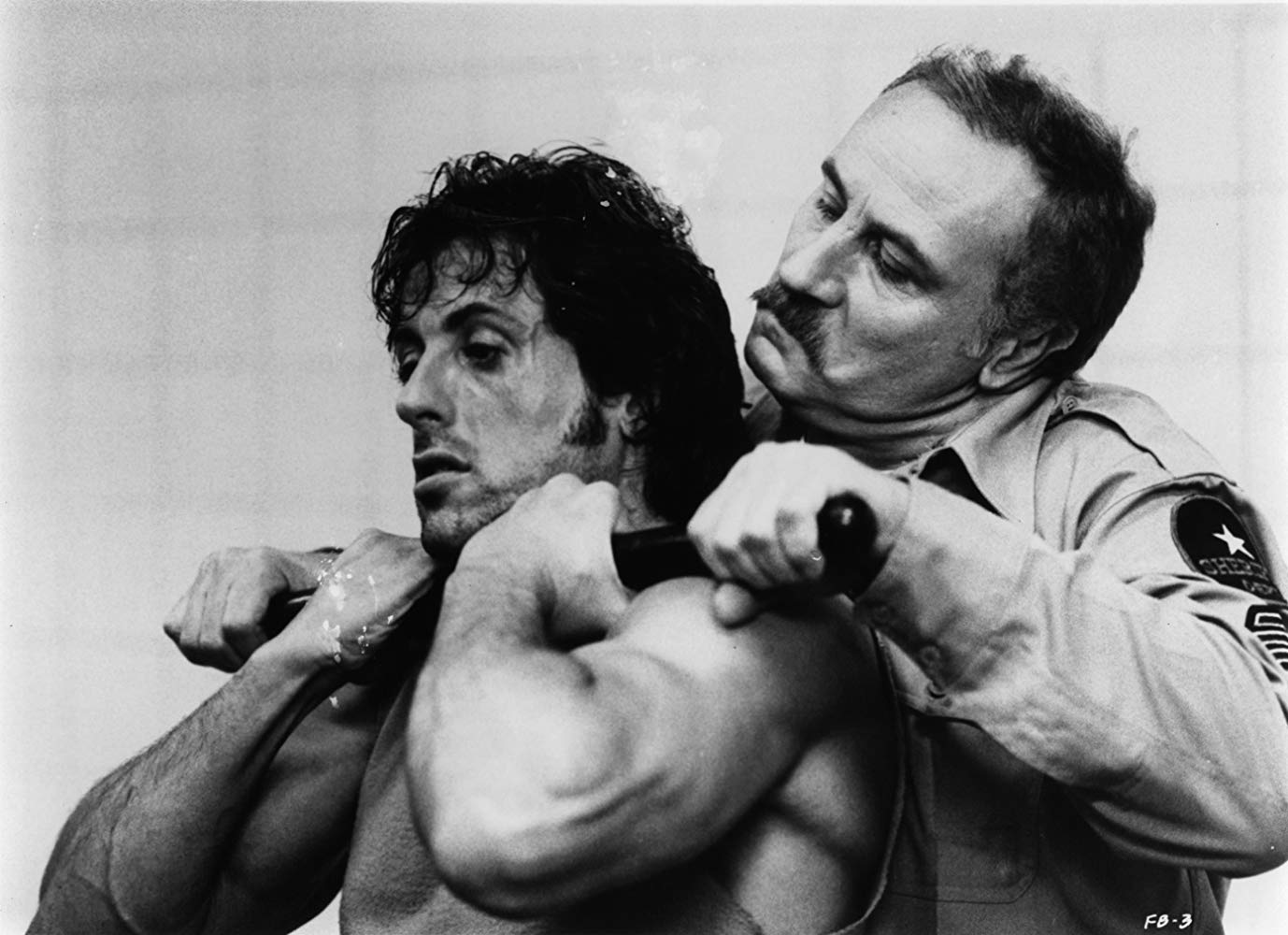
The movie begins with Rambo visiting an old war buddy who has died from the after effects of chemical warfare, his last connection to the world evaporating in a figurative cloud of Agent Orange. What we find is a dishevelled patriot, a wanderer who arrives home as a stranger in a strange land and is immediately treated like one. From the very outset Rambo is victimised, a young man whose sombre, un-American façade sticks out like a half-mast flag, commanding neither respect nor sympathy from a generation who are more concerned with his haircut than any semblance of inner character. Sheriff Teasle (Brain Dennehy in scintillating form) judges first and asks questions later. In doing so he represents the entire town, and by extension towns across America.
Rambo is suffering from Post Traumatic Stress Disorder (PTSD), every act of aggression, no matter how small or trivial, enough to trigger the killer instincts that boot camp have drilled into him and the horrors of conflict that carved them in stone. After being arrested and maltreated by the slack-jawed officials of a small-town precinct, those horrors come screaming home, Rambo fleeing into the wilderness with a particular set of skills that dwarf those of men who were somehow deemed worthy of policing the region where he holes-up indefinitely. All they see is a hippie vagrant polluting their territory and mocking their sense of pride and order. This reflected the mood of America’s older generation, former war heroes who were still staunch proponents for collective triumphalism. Elsewhere, the likes of Rambo were seen as either brainwashed dogsbodies doing the devil’s work or unfortunate pawns who had left as patriots and returned home as emotional zombies.
As Stallone himself would explain in an interview for Drawing First Blood, a behind the scenes look at the making of the movie: “I had mixed feelings about the war. At the beginning I was very much behind the war, and then I felt that the soldiers were getting kind of a raw deal because around ’70 you realised there was no chance for us to win this war, and it became a different kind of war—a war of attrition—and the soldiers had no choice. I had a real problem with calling them ‘baby killers’ and spitting on returning GIs. I thought it was horrible. And I knew they’d been terribly slighted.
First Blood was in development for what seemed like an eternity, but the idea of adapting it for the screen was almost immediate. Released in 1972, a whole decade before the movie saw the light of day, David Morrell’s thought-provoking novel was picked up by Colombia Pictures, who immediately sold the rights to Warner Brothers. Vietnam Movies had already made huge commercial waves and the war had become hot property. At the time, First Blood was the most optioned screenplay in Hollywood.
Twenty-six scripts went through five studios before modest, low-level producers Andrew Vajna and Mario Kassar decided to take a punt on what Ted Kotcheff described as a ‘great property.’ All the pair needed was a marquee name, and Sly was the first that sprung to mind after the monumental success of Rocky, another underdog story that had captured the imagination of America. To their astonishment, the burgeoning megastar soon answered their call. “We sent [the script] to him on a Monday,” Kotcheff explained, “and by Tuesday afternoon Sylvester Stallone answered and said he was gonna do it. In the whole history of my filmmaking — forty years of directing films — this was the first time that a) I got my first choice and b) that I got it within twenty-four hours.”
How blind are you? Can’t you see this guy’s crazy?
Deputy Mitch
Initially, Sly was nervous about what he described as a “jinxed project”. Insecure regarding the movie’s drawn-out production, he wondered why so many directors had passed on it; why Academy Award winners such as Gene Hackman and Robert Duvall had rejected the role of Sheriff Teasle; why Kirk Douglas — an actor whom Stallone had “analysed as a young man” —had quit over script disputes (ironically, he had wanted the movie to stay truer to the much less heroic novel, insisting that his vision was more ‘artistic’ and that “Rambo must die”).

But this was Stallone, a man with an unquenchable sense of ambition, and a suggestion from producers that he himself finish the script was enough for him to buy into the character, taking the movie even further from its source material by insisting that Rambo be a more sympathetic character who would survive events by not directly killing anyone. When it came to understanding the American public, Stallone was a master, and such changes, though detrimental to all ambitions of making a serious Vietnam movie, were no doubt vital to First Blood‘s widespread commercial success. As the director himself explained, “Sylvester has this great popular sense. He knows what the movie public likes to see and what they don’t like to see.” After the sobering, post-Watergate 70s, action fans wanted heroes who they could sympathise and identify with without getting bogged down in the brutal realities of humankind’s less desirable tendencies, and, despite First Blood‘s more grounded elements, Rambo was certainly one of them.
As well as his invaluable commercial savvy, Sly brought a sense of rough and tumble to proceedings, committing to approximately three quarters of the stunts featured in First Blood (many of them fairly dangerous) in little more than a tank top in temperatures of -40. The film’s Hollywood-friendly vision may have lacked authenticity to some extent, but in terms of action the movie soaks you to the bone, particularly during its second act as we indulge in Guerrilla warfare in the savage wilds of British Colombia. Kotcheff gives us what is essentially a forest-bound variation on the slasher flick, a barely-glimpsed Rambo picking off his helpless prey, or at the very least sending them a harmless warning in a manner that they are unlikely to forget in a hurry. Because of the location’s harsh temperatures and unpredictable terrain, the movie was also tough to shoot, Hungarian-American cinematographer Andrew Laszlo (The Warriors) weathering the storm to produce some of his finest work.
Despite First Blood‘s thematic legitimacy, the eventual casting of Brian Dennehy and Richard Crenna as Teasle and Trautman makes for a very different picture to the one that Kirk Douglas, and probably most of Hollywood, had originally envisioned at a time when anti-war sentiments had become fashionable. Both are fine actors, but they slip into the more formulaic action formula with consummate ease, proving perfect vessels for a screenplay that openly embraces action entertainment. Perhaps the most timeless asset that the movie possesses, the element that allows First Blood to stand tall all these years later, is Jerry Goldsmith’s reflective, battle-worn score. His regretful, commemorative horns lends Rambo the proud, sympathetic aura that Stallone craved. Goldsmith is one of the finest composers that the industry has ever known, right up there with the Williams’ and Morricone’s of the world. The value of his contributions here can not be underestimated.

First Blood may have one combat boot firmly in reality, but its success depended almost entirely on its star attraction, and many of the movie’s perceived weaknesses are actually its strengths. One of Sly’s biggest no-nos was that you never kill the hero, or as he himself put it “Rocky can’t die”. This would prove the right decision following a test screening featuring an alternate ending in which Rambo took Trautman’s pistol and shot himself dead after a speech involving the irreversible process of being turned into a programmed killer. As Kotcheff would explain, “The audience were into it. We felt immediately that we had a success on our hands… they’re with him all the way, and then suddenly there was a dead silence when he got killed. And a voice said ‘If this director is in this audience, he should be strung up from the nearest lamppost.”
Once those wish-fulfilment cracks had been papered over, distributors across the world would take the Rambo bait, the end of the screening described by Richard Crenna as being like “The New York Stock Exchange”, an immediate bidding war precipitated by Japanese investors who were literally waving cheques in the air. So widespread was the demand that First Blood became the first movie in the United states that was able to separate the rights across different distributors: video, cable and domestic. The movie would also represent the biggest October release in history up to that point, smashing all expectations with its unique blend of reality-based drama and mainstream action. Despite Stallone’s initial fears, they had concocted the perfect recipe at exactly the right time.
They drew first blood, not me.
John Rambo
By 1982, many US citizens had accepted the fact that their veterans had been used as scapegoats in matters that were beyond their control, but there was also a desire to leave the past behind and move on after years of emotional turmoil. Movies such as Francis Ford Coppola’s unsentimental and gruellingly authentic Apocalypse Now had delivered gut-wrenching doses of hard-hitting reality, revealing sad truths that were unbearble, and though there was a mini Vietnam movie resurgence in the mid-80s, the studios were ready to move on too. The American government were also sick of being hammered, which is why John Carpenter’s Escape From New York, an anti-fascist dystopian classic featuring a corrupt president, failed to see the light of day until 1981, years after the screenplay had first been pitched.

First Blood is like the mainstream antidote to the Full Metal Jackets of the world. It conveys unpatriotic truths in a patriotic fashion. It portrays the aftermath of the Vietnam War with semi-serious intentions but packs enough testosterone to be embraced as Hollywood fantasy. It is an action movie first, a political commentary second, and as a mainstream vehicle it works wonders, with a lead character who pre-empted the kind of mainstream action star that rival Schwarzenegger would build an entire career out of. In some ways Rambo was the true progenitor of the musclebound, all-action 80s.
Stallone’s Rambo sequels would adopt more polemical patriotic sentiments, the kind that bordered on the xenophobic. Gone was the soft-spoken antihero, the misunderstood residue of a civil rights-bolstering conflict replaced by a Cold War warrior who flew the flag for Reaganite politics, the screenplay’s modus of unwilling violence replaced by a relentless killing machine who became an emblem for the Top Gun 80s and a proponent for American exceptionalism. Were those movies representative of Rambo’s true colours? They had very little to do with David Morrell’s original creation, and though First Blood retained a fair whack of what made that character so compelling, wish-fulfilment would win the commercial war.
The fact is, you don’t forge a franchise juggernaut like Rambo based on realism alone. The majority of moviegoers don’t pay to be confronted by the world’s real-life horrors. It is much easier and less intimidating to see things in black and white every once in a while, to overlook the harsh realities and embrace the fantasy. Cinema is about escapism, about vicarious thrills and easy answers. For those who see through the spurious nature of politics, or for those who have simply given up caring, sometimes it’s just fun to watch make-believe characters blow holes in each other. I guess there’s a little Rambo in all of us.
Director: Ted Kotcheff
Screenplay: Michael Kozoll,
William Sackheim &
Sylvester Stallone
Music: Jerry Goldsmith
Cinematography: Andrew Laszlo
Editing: Joan Chapman







 vhsrevival.com