


The inimitable Walter Hill returns to the buddy cop formula he helped revolutionise, but could he manage top tier Arnie as the star neared his commercial apotheosis? VHS Revival investigates
Back in 1988, Arnold Schwarzenegger wasn’t only the premier action star in Hollywood, he was one of the biggest superstars in the entire world. Success came naturally to the industry’s most unlikely megastar. The ‘Austrian oak’ had already left behind provincial life to become one of the most successful bodybuilders in history, and in a decade of bigger is better, Arnie’s musclebound excess not only fit the action star profile, it defined it. Schwarzenegger wasn’t a particularly good actor. To begin with he was terrible at best, struggling to adapt to the English language and failing to loosen his clunky diction, but what he had was determination in abundance. He was also incredibly charming beneath the brick wall façade, and, most importantly, he knew how to get ahead in the dog-eat-dog realms of commercial capitalism.
After bursting onto the scene as Conan the Barbarian and being shrewdly cast as the suitably cold Cyberdyne Systems Model 101 Series 800 Terminator, Arnie would star in a succession of cult action and sci-fi blockbusters that launched him to a new cultural stratosphere, mainstream winners such as the ludicrously hypermascualine Commando, dystopian Stephen King adaptation The Running Man and John McTiernan’s Jungle-bound classic Predator catering to his inimitable charms. By 1991, just as Cameron had unleashed a newly reprogrammed ‘good guy’ Terminator in what was then the most expensive movie ever made in Terminator 2: Judgment Day, Arnie was in the midst of excepting only family-friendly roles as he looked to ingratiate himself with political circles, and we all know how well that went. Despite the critics and naysayers who were eager to pigeonhole Arnie as a bumbling birdbrain, whatever he turned his hand to he came up trumps.
For those of us weaned on a diet of Arnie’s priceless one-liners, the majority of those movies were a blast. People may have been critical of Paul Michael Glaser’s gaudy take on The Running Man; they may have cried foul over Paul Verhoeven’s similarly mainstream Phillip K. Dick adaptation Total Recall; hell, there were some who wrote Arnie off as lowbrow trash whatever the movie, but you don’t get to the top of the mountain off the back of sheer dumb luck. There were a thousand and one gripes that could be levelled at Arnie and the majority of his star vehicles, but that was besides the point. What Arnie had in abundance was that illusive, almost intangible quality known as charisma; and not your typical kind. He wasn’t loud or fast-talking or in your face; he wasn’t particularly handsome or skilled or knowledgeable about the creative side of things. In fact, he was quite the opposite: careful, considered and emboldened by a quiet sense of ironic self-awareness. Ultimately, he was a true original.
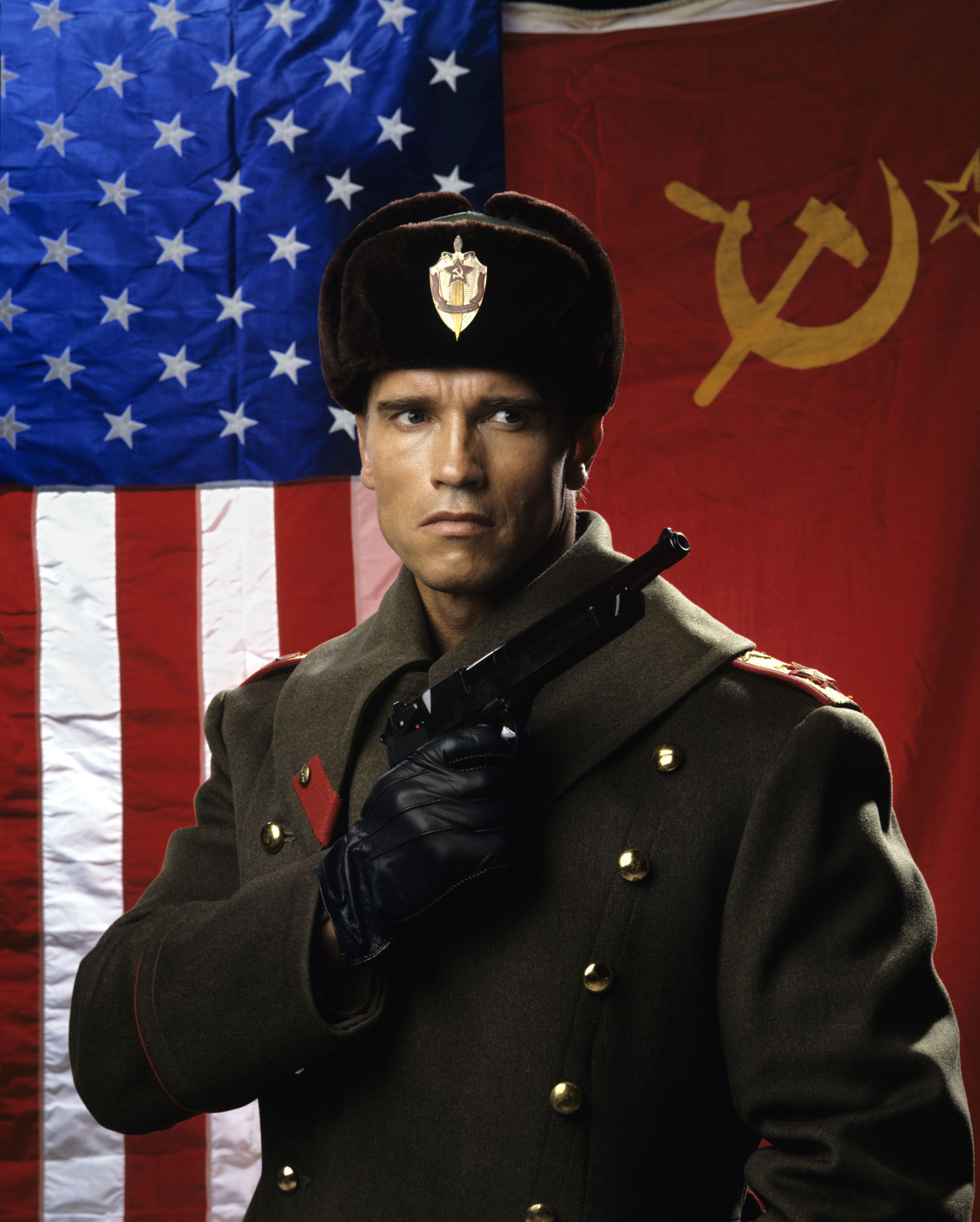
In the realms of mainstream Hollywood, it seemed that Schwarzenegger could do no wrong, but were his movies really as consistently entertaining as many of us remember? To be honest, I always seem to go back to those same movies over and over. Since their release, I must have seen Commando and The Running Man fifty times apiece. Predator, The Terminator, and Terminator 2: Judgement Day? I honestly couldn’t tell you how many times I’ve experienced those movies in my lifetime. I’ve even seen James Cameron’s inspired action comedy True Lies at least a dozen times, and I must admit to having a bit of a soft spot for the likes of Twins and the absolutely ludicrous Kindergarten Cop, a movie in which Arnie’s comic approach grew into something much more obvious. There’s just something about Arnie’s delivery, whether the material is overt or not, that tickles me just right. Stick the guy in an ironic predicament and I’m immediately sold.
Very strange city. The crime is organized; the police is not.
Ivan Danko
But what of those action movies that I rarely, if ever, return to? Specifically, I’m thinking of John Irvin’s violent, 1986 actioner Raw Deal and Cold War buddy flick Red Heat. The latter, in particular, was a movie that got me hyped as a young action fan; the fact that I remembered very little about it making me particularly curious upon a recent re-watch. I was somewhat surprised, then, to discover that the movie was actually written and directed by Walter Hill. This was the same Walter Hill who revolutionised the buddy cop picture with Eddie Murphy action/comedy 48 Hrs., the same who brought us iconic, splash panel gang warfare flick The Warriors and cult neo-noir rock musical Streets of Fire. Hill had a knack for cynical comedy. He was also renown for violence and gritty aesthetics, striking a unique balance between down to earth action and grandiose presentation. In fact, when I read his name on the poster I narrowed my eyes a little. Arnie and Walter Hill? It was a pairing I never imagined existed.
I saw Red Heat long before I was aware of Walter Hill, before I even knew what a director was. The most I could remember was that is starred Arnie and James Belushi, someone I recognised from another, slightly less conventional buddy cop movie in 1989’s K-9 — admittedly a favourite of mine as a youngster. The younger sibling of the universally loved and deeply tragic John Belushi, James, who followed in his brother’s footsteps until his premature death to a cocaine-related overdose in 1982, always had a lot to live up to, but he was fairly likable with a solid grasp on mainstream comedy, his hyperactive American Joe schtick seemingly a good match for Arnie’s immovable magnet for self-aware humour. By 1988, screenwriters such as Steven E de Souza were queuing up to write borderline derisory quips for Schwarzenegger. Roger Moore had already retired the Walter PPK following 1985’s A View to a Kill, the punctuation mark on an era of eyebrow-raising quips, and with Timothy Dalton headlining a short-lived period of Fleming-esque Bond, nobody did it better than Schwarzenegger.
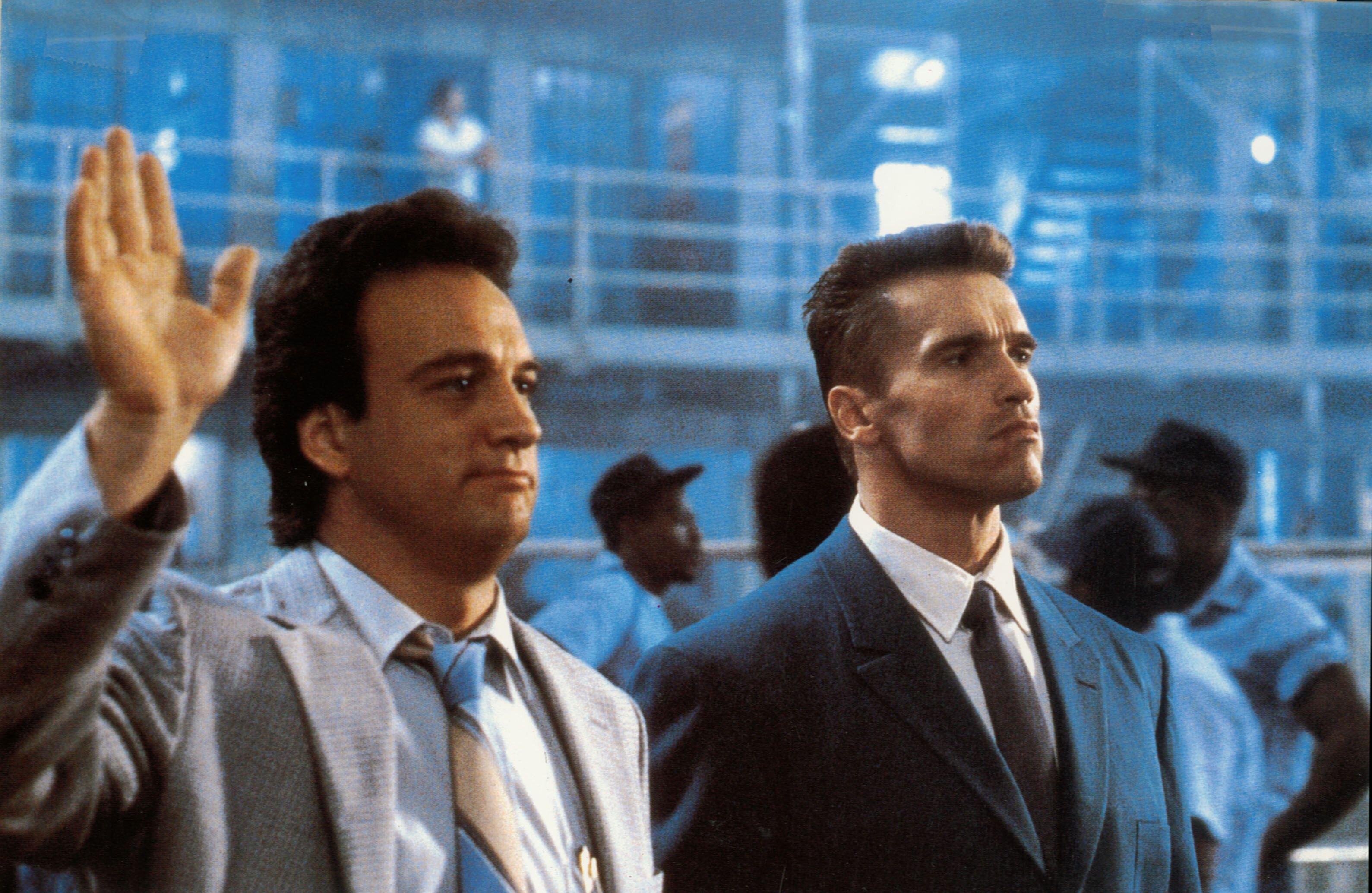
In terms of plot, Red Heat doesn’t throw up any real surprises. This is frenetic car chases, hyper-tense shootouts, and a revenge angle related to drugs, another hot topic in America under the Reagan administration. It also relies on a political formula that had already been done to death by the time of the film’s release: the Cold War, which was also nearing an end after more than 40 years of ideological conflict. This is reflected in the movie’s tone, which portrays Arnie’s Moscow Captain Ivan Danko (sound familiar?) as a powerful hero, albeit one with different beliefs and methods. For years the Soviets had been portrayed as ice-cold killers, most famously in Arnie adversary Sylvester Stallone’s decadent sports sequel Rocky IV, Dolph Lundgren’s Ivan Drago a flesh sickle intent on smashing the American dream. Though Danko and Belushi’s Detective Sergeant Art Ridzik are your typical odd couple at first glance — the former a mother Russia saluting buzz cut, the latter a hot-headed windbag with high cholesterol — their unlikely coming together, though a cliché in itself, does offer a degree of freshness.
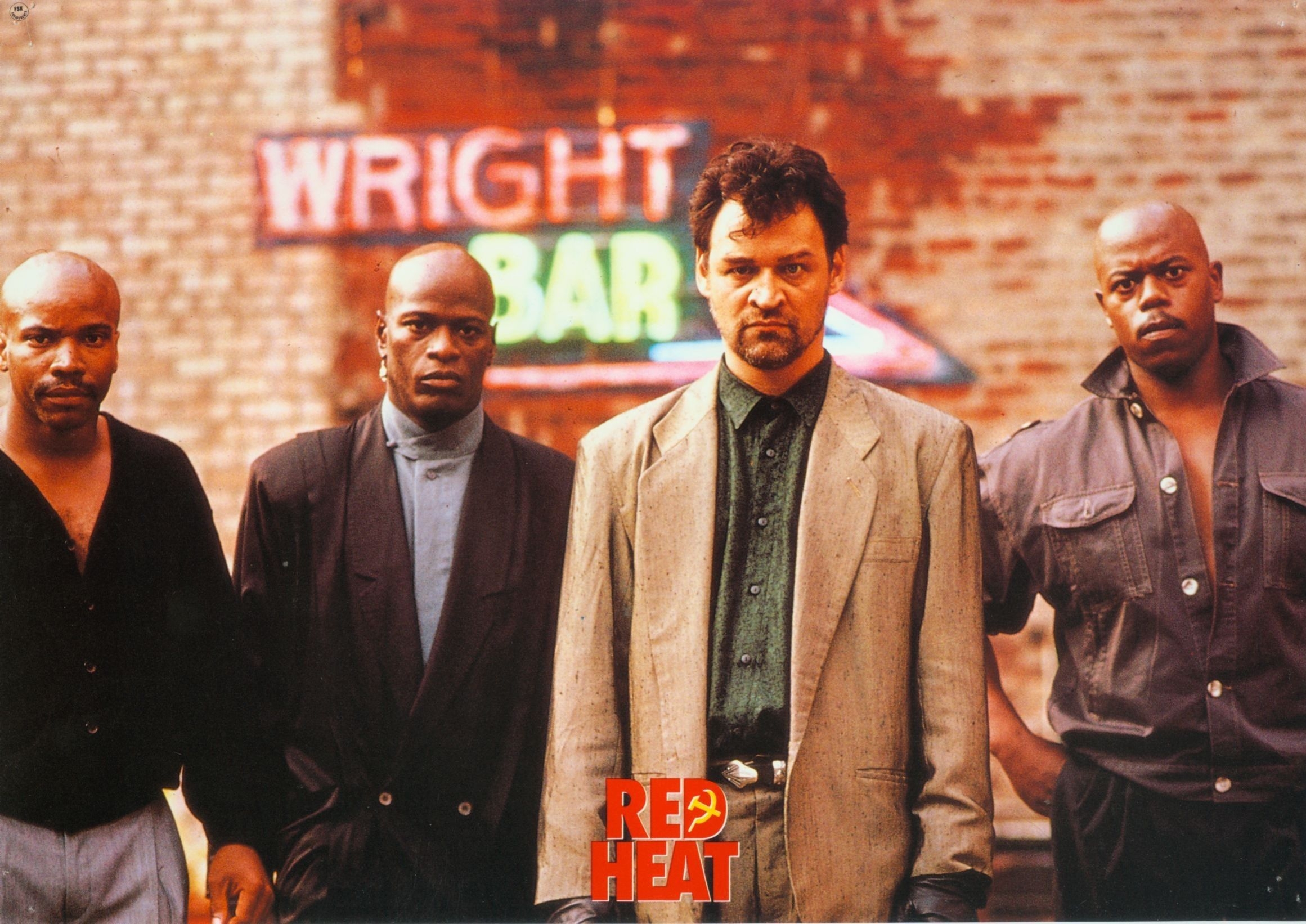
Being almost forty years olds, Red Heat can still be painfully formulaic at times, giving us an eternally pissed police Captain (Peter Boyle), a bureaucratic upstart (an exceedingly young Laurence Fishburne) and enough token bad guys to make you clutch your bloodied chest and leap through a plate glass window, but it presents our two leads, much like Richard Donner’s superlative Lethal Weapon released a year prior, very much as equals, despite their cultural differences. It also benefits from a superlative villain, Ed O’Ross in devilish form as a Georgian drug dealer who flees to the States on business after murdering Danko’s partner and friend. In a pre-‘Sopranos’ era short on fundamentally evil antiheroes, O’Ross’s Viktor Rosta even manages to come across as reasonable amid the cold-blooded murder and ruthless double-crossing, though audiences would probably have read it differently almost forty years ago. “You killed my friend,” Danko threatens during a tense stand-off in the shadows of a desolate car park. “You killed my brother”, Rosta snarls in response, before concluding, “A dead man is a dead man.”
Fair point.
Oh, come on, everybody knows the .44 Magnum is the big boy on the block. Why do you think Dirty Harry uses it?
Art Ridzik
Arnie is less charming than you might expect in Red Heat, and seemingly by design. Most of the movie’s quips are reserved for Belushi. Some of them hit, some of them miss rather badly. In a hyper-sensitive 21st century climate, much of this can be attributed to our changing attitudes, Belushi’s sexist and xenophobic pops giving his character an unlikable quality in hindsight, and compared to the likes of Mel Gibson and Danny Glover, who had set the bar as lethal weapon Martin Riggs and ‘too old for this shit’ potential retiree Roger Murtaugh, the chemistry of Red Heat‘s mismatched duo can feel lukewarm at times. The movie’s final showdown, a game of chicken featuring two buses, is also something of a damp squib. The plot can meander too, particularly a sub-plot involving a young and talented Gina Gershon as Rosta’s unlikely token wife and unwilling accomplice, but with Hill driving affairs, it’s never less than competent.
Red Heat does successfully blur the margins of formula, toying with expectation in order to subvert it. The movie is refreshing in the sense that it attempts to find common ground between two men who are expected to be politically and ideologically opposed, the two possessing capitalist and communist habits and sentiments that are completely at odds, but it stops short at a by the book foil, Danko and Ridzik both bending the rules in ways that are presented as being exclusive to each culture. Danko will break your fingers or slam your head against a wall in his quest for answers, while Ridzik is more likely to go for the quick pay-off or dabble in some evidence planting — the American way. Ultimately, the two are cops in search of justice, which is enough to iron out the too-few awkward moments on display in Hill’s above average but below his usual standards script.
Ultimately, Red Heat falls short of top tier Arnie. You’re not going to find too many iconic lines in the Commando, Running Man and Predator mode. The action sequences — a ludicrous, near-naked stand-off in a Russian bathhouse-come-gym-come-steel refinery not withstanding — are tough, with a gritty Hill aesthetic, but lack the imagination or slight comic touch of the late-80s formula, which had already outgrown this particular movie by 1988. Much of the problem lies with Belushi, though through little fault of his own. Arnie, at home as the ice cold machine on the destructive warpath following his Teutonic turn as Conan and ice cold, career-making performance as the T-800, is on the money, but Hill’s decision to tone down his wisecracking persona may not have been the smartest choice at this point in the actor’s career. Belushi does everything right, but he has too much weight on his shoulders thanks to the film’s swerving of audience expectation. With the momentum he had going in, this should have been Arnie’s role.
Arnie had never really been one for pairings. He usually had a token love interest or ill-fated secondary companion to soak-up his string of one-liners, but he’d never really had anyone to bounce off of at that stage in his career, and the back-and-forth model fails to get the best out of him. Later that year, the brilliant Danny DeVito would make a better foil in Twins, a movie that would ultimately dwarf Red Heat at the box office, and star vehicles such as 1994’s True Lies had the benefit of a more mature comedic actor, the always wonderful Jamie Lee Curtis, an inspired Bill Paxton and James Cameron’s unwavering dynamism. Ultimately, Red Heat, a somewhat bold experiment that falls short of Hollywood magic in an era that gave us action maestros such as John McTiernan and Richard Donner, is not as creative, assured, or as commercially astute in its intentions.
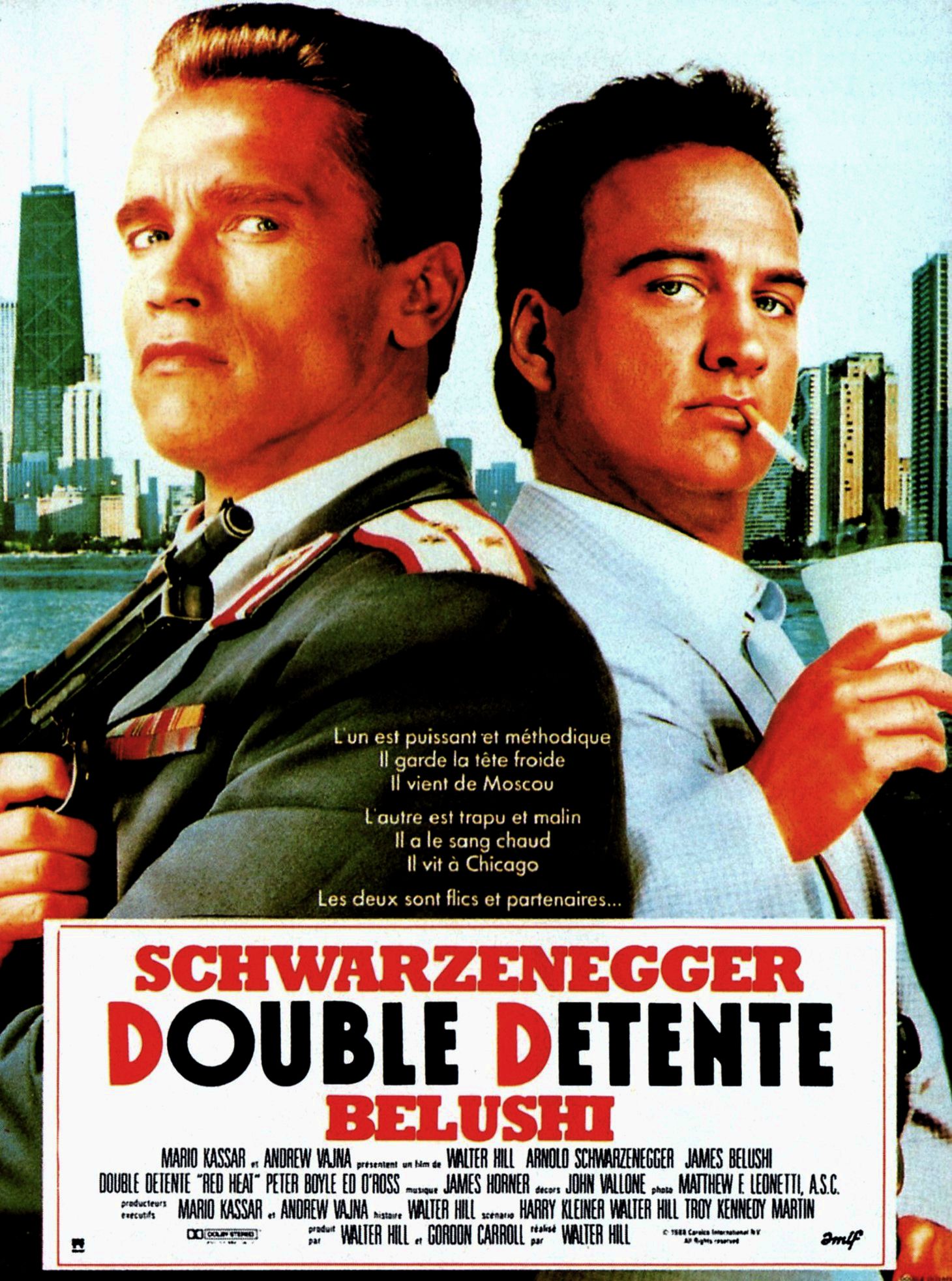
Director: Walter Hill
Screenplay: Walter Hill
Cinematography: Matthew F. Leonetti
Music: James Horner
Editing: Donn Aron, Carmel Davies &
Freeman A. Davies








 vhsrevival.com
I remember a cheap Arnold biography we bought at Costco in the 90’s that suggested that the bolder move would have been to cast Arnold as Ridzik and let Belishi play the Soviet cop Ivan Danko.
LikeLike
Imagine! What an interesting thought.
LikeLike