
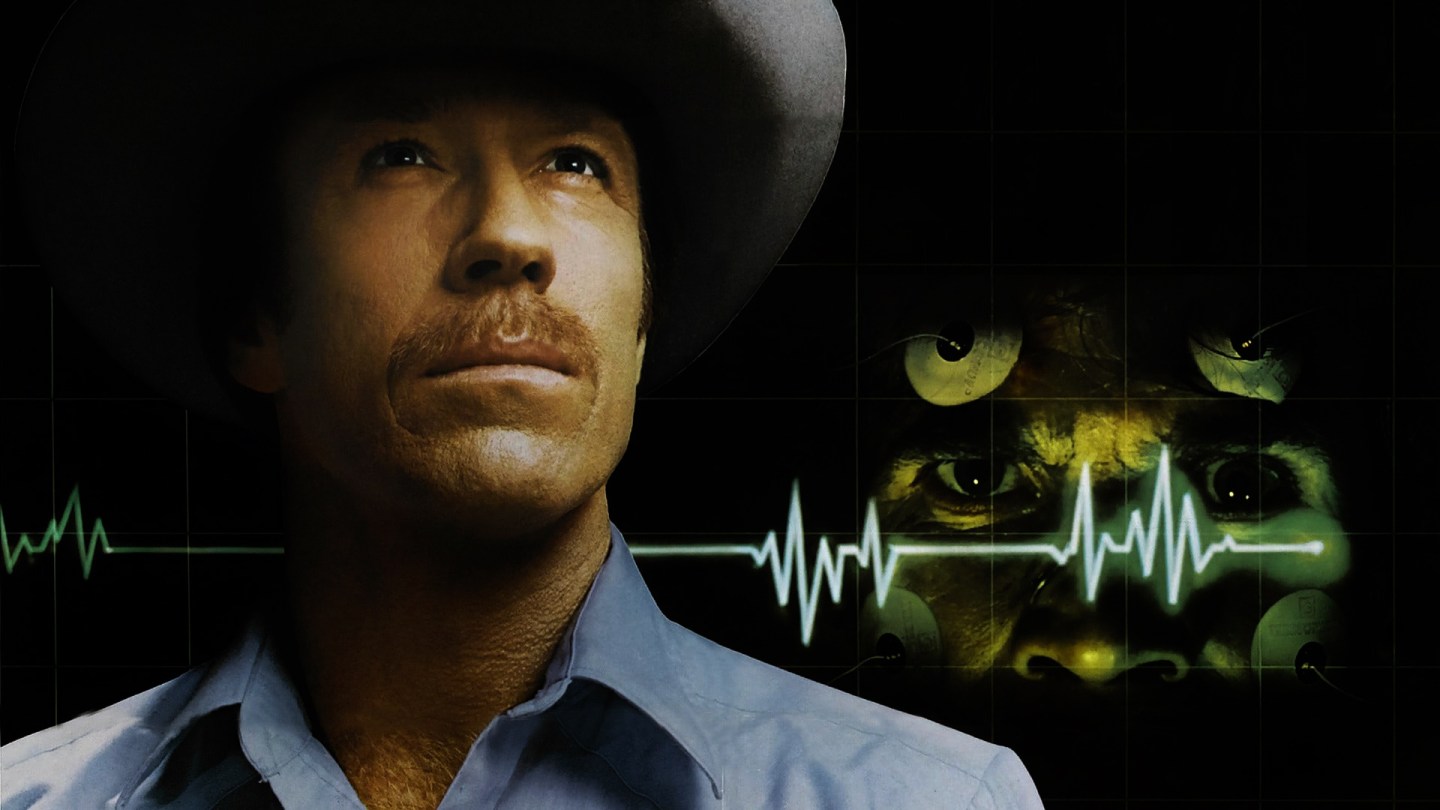

Director: Michael Miller
X | 1h 40 min | Action, Horror, Sci-Fi
Of the 32 movies that legendary cult figure Chuck Norris has starred or featured in since he first appeared as an uncredited extra in Phil Carson’s 1986 spy comedy The Wrecking Crew, I never once imagined that I’d see him headlining what is essentially a slasher. I say essentially because 1982’s Silent Rage is a commercial hodgepodge of action, science fiction, and horror, with a dash of screwball comedy and a series of sex scenes that are shot and scored with the softcore romance of a sex video marketed at married couples seeking to spice up their sex life in the most harmless way imaginable.
The latter elements can be attributed to director Michael Miller’s resume, which mostly consists of made-for-TV romantic dramas and Danielle Steele novel adaptations such as Dangerous Passion and A Perfect Stranger. Miller’s commercial peak came in the form of 1982’s John Hughes penned comedy National Lampoon’s Class Reunion, which explains the bawdy moments of sexual hi jinks and a deputy sheriff who proves so puerile and unconvincing that you at the very least want to punch him in the face repeatedly, longing to see him cut to ribbons by the movie’s dead-eyed antagonist after every skin-crawling utterance. Replace this irredeemable idiot with a half-decent sidekick and the movie’s credibility increases by one thousand percent, but the unique, monotone charisma of Chuck more than makes up for it.
Norris first made a name for himself as Bruce Lee opponent Colt in Lee’s only complete directorial film Way of the Dragon, released in the US as Return of the Dragon. Norris, who played a martial arts master, would duel it out in an epic battle at the Colosseum in Rome, Lee and his crew bribing officials and posing as tourists as a way to sneak in equipment, illegally filming one of the late star’s most iconic scenes. Lee and Norris became sparring partners, but the idea that Lee was a teacher to Norris is something of a myth. Norris was already a prominent martial artist and national karate champion by the time he met Lee, the two learning from each other’s styles and becoming better fighters for the experience.

By the time Silent Rage made its way into theatres, Norris was already an established action star thanks to profitable, low-budget hits such as Ted Post’s Good Guys Wear Black and Eric Karson’s The Octagon, which also starred western stalwart Lee Van Cleef, but it was his run with The Cannon Group as a Golan-Globus headliner that elevated his action star status, Norris starring in such action movie classics as Invasion U.S.A., The Delta Force and the Missing in Action series. Ironically, by that point in his career, an aging Norris was looking to tame his martial arts output, opting for movies with an emphasis on weapons combat, which is one of the reasons why he turned down the lead in 1985 Cannon classic American Ninja, which after initial press releases featuring Norris was recast to feature up and coming action star Michael Dudikoff.
With movies such as Death Wish II and Invasion U.S.A. under their belts, The Cannon Group were no strangers to exploitation, unsuccessfully embracing the red-hot slasher genre during those early years, and with an eclectic array of genres that included Indiana Jones rip-off adventure film Allan Quatermain and the Lost City of Gold, Oscar nominated films such as Andrei Konchalovsky’s Runaway Train and even movies about breakdancing (Breakin’ and Breakin’ 2: Electric Boogaloo), they were eager to branch out into every imaginable territory in their ambitious attempts a mainstream success, culminating in a hit and miss, two-movie deal with Hollywood megastar Sylvester Stallone (Cobra and Over the Top), and an ill-fated punt at franchise hegemony with colossal mainstream flops Superman IV: The Quest for Peace and popular cartoon spin-off Masters of the Universe. All in all, it was a successful approach.
With Silent Rage, Top Kick Productions and Columbia Pictures took a similar approach, throwing all manner of ingredients into a pop culture blender in the hope of squeezing out the juice. This would lead to a review in Variety that suggested that the film was made, “with a demographics sampler entitled ’10 Sleazy Ways To Cash In On The Exploitation Market.” The movie opens with a double axe murder, including an absolutely shameless recreation of the ‘Here’s Johnny!” moment from Stanley Kubrick’s The Shining, released two years prior. The culprit is mental patient John Kirby, seemingly on release from a local institute and boarding with a local family. The choice of housing is questionable for two reasons. The first is the fact that the family has several rambunctious kids, which must be breaking some kind of law, even in the heart of Texas in 1982. The second is the fact that the family matriarch is a relentless gobshite who is, in the words of Morrissey, ‘enough to make a shy, bald Buddhist reflect and plan a mass murder’. Norris’s Sheriff Dan Stevens is soon on the scene, but the captured Kirby somehow snaps his handcuffs, rips off the door of a police cruiser and even survives a near-fatal shotgun blast by the skin of his tightly clenched teeth. Even before the introduction of the film’s laughably tenuous pseudo-science, this is one bad dude we’re dealing with here.
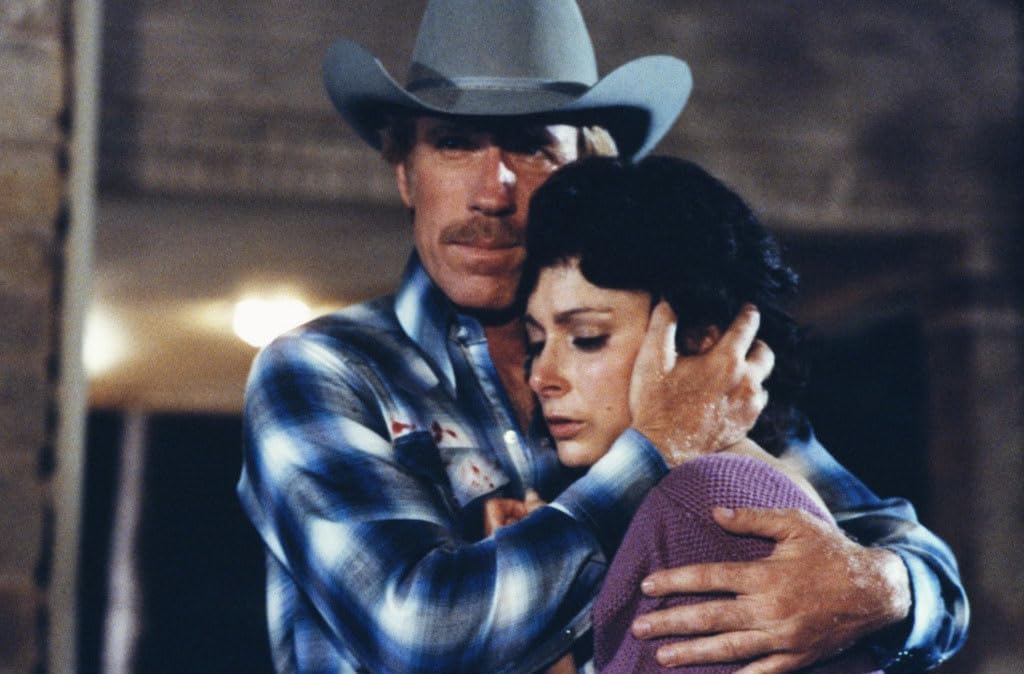
Unwilling to let his psychotic patient die in peace, or, to be more accurate, longing to test a genetic formula designed to enhance cellular strength and regeneration on a human patient, Dr Phillip Spires, who approaches the subject with the barely repressed fanaticism of Re-Animator’s Herbert West, not only resurrects John, but provides him with the kind of superhuman regenerative abilities that would make the X-Men green with envy. In one of several moments that somehow mirror Terminator 2: Judgment Day, which wouldn’t be released until a decade later, lacerations heal almost immediately, gun shots have absolutely no effect, and even fire seems but a momentary obstacle, no more serious than a speck of dirt in the eye, in our maniac’s insatiable conquest for human disposal. I wouldn’t be at all surprised if James Cameron caught this movie on TV and was subconsciously inspired by it.
Caught in the middle of Spires and his colleague Dr. Paul Vaughn’s subterfuge and Sheriff Stevens’ demand for a corpse is the late Ron Silver’s Dr. Tom Halman, and by proxy his sister Alison, who just so happens to have had previous relations with the Sheriff for over half a decade, which makes her brother’s lack of knowledge of him highly improbable; but hey, we’re not expecting any Academy Awards for screenwriting here. Alison is played by the adorable Toni Kalem of The Sopranos fame, who would hone her craft considerably in the ensuing years, even if, along with Silver, she is the best performer in the entire movie. At the other end of the spectrum is Steven Furst’s aforementioned Deputy Sheriff Charlie, a stupefyingly irritating, comic relief nincompoop whose bumbling ineptitude and general lack of a spine proves so infantile that you just want to scream every time he opens his mouth. To be fair, the character is so badly written and ill-fitting with the overall tone that the actor didn’t stand a chance.
In some ways, Silent Rage acts as a precursor to not only Chuck’s Golan-Globus run, but to his popular nine-season run as the eponymous Walker, Texas Ranger. Aside from the opening double murder, there isn’t a hint of slasher action in sight during the movie’s opening forty minutes, which basically consists of half-assed cod-science, puerile comedy moments involving the Sherriff and his risible, man-baby sidekick, some tacked-on action sequences involving chuck and a biker gang who barely land a blow between them, and a series of chauvinistic sex scenes that paint Alison as a needy, sex-starved dependent who, despite her weak, deftly dealt with protestations, is putty in her hairy beau’s hands. Not that Chuck is lecherous. He’s far too cool and agreeable for that kind of malarky. He is calm, collected, a complete gentleman, but also confident in his sexual prowess, casually waiting for the inevitable like a player who’s in total control. And Kalem is as cute as they come.

The movie’s last hour lets Chuck flex his muscles to a degree, but Silent Rage becomes a straight-up slasher once John disposes of his creators to become a bona fide Frankenstein’s monster, exhibiting a cold brutishness that is completely in line with the genre’s golden age. In an irrepressible killing spree that lasts barely a few hours, John racks up the body count, but in an era of coldblooded, practical effects overindulgence, golden age fans may be disappointed. Those who are in love with SFX artists like Tom Savini, who would make physical mutilation an artform in the early 1980s, despite the various protestations of censorship naysayers, will find nothing of the sort here, even if stuntman Brian Libby does carry himself with an intimidating aura.
“He reminded me of Lee Marvin,” director Miller would say when discussing Libby’s obvious suitability for the role. “He came in and I thought, Okay, this guy can play Frankenstein’s creature. He was a real cooperative kind of guy. He never balked about anything. I put him in a silver suit, and put him through a lot. A lot of other actors would have thought that was beneath them, but he wasn’t like that.” Miller was also adamant that he had no intention of cashing-in on the hugely popular slasher, despite the inevitable comparisons, adding, “I’m not a fan of those. When I read it, I thought that it was Frankenstein. That’s what I was heading towards. We’ll have the mad scientists bringing this guy back to life. Chuck will have to try to apprehend him.”
With a budget of only $600,000 to play with, the prospect of making a blood and guts slasher in the 80s mode was virtually non-existent, but with a series of POV shots and the occasional suburban menace of John Carpenter’s hugely influential Halloween, a similar, if vastly superior low-budget effort which also didn’t rely on gore to be effective, as well as a rather familiar scene featuring a terrified victim in a wardrobe, and even similarities with cruder efforts such as Joe D’Amato’s cynical video nasty Absurd, all of it complemented by a suitably slasher-esque, synth-driven score, it’s hard to believe that the genre and its many tropes, be that subconscious or otherwise, didn’t work their way into Miller’s overall thinking. I’ll let you be the judge of it.
Gross Negligence
Doctor’s have been known for their arrogance, many of them inflicted by the dreaded God complex, but Messrs. Spires and Vaughn take the prize with their nefarious intentions and relentless subterfuge.
Not only do they keep psychotic murderer John alive and well with their magical life-preserving formula, they do everything in their power to hide their regeneration antics, even after their patient disappears and returns, caked in blood, after killing two victims with his bare hands, leading to all manner of deaths thereafter.
At least they were added to that long and pointless list.
The Imbecilic Arm of the Law
The insufferable Deputy Sheriff, Charlie, who isn’t man enough to warrant a credited surname, is at once courageous and cowardly, self-pitying and absolutely full of himself, a terrified virgin and… a man capable of sexual assault?
In one particularly contradictory scene, Charlie walks into a biker bar all balls and fury, only to shrink like erectile dysfunction when approached by a bare breasted biker chick looking to emasculate him. But out of nowhere he reaches out to fondle them, licking his lips like a crazed pervert until Sheriff Dan warns against it.
He is on duty, I suppose.
It Absolutely Will Not Stop… Ever, Until You Are Dead!
Slasher or no slasher, director Miller must have had some kind of filmic time machine that he refuses to acknowledge. There are obvious similarities with the Terminator character at play here, particularly during an action-packed finale that exhibits John’s indestructability, to the point where Miller actually left Silent Rage open for a sequel with a pre-end credits, sequel-setting scare, but it goes deeper.
During Sherriff Dan and Alison’s getaway, an irrepressible John grabs onto Dan’s pickup truck T-1000 style, holding on at full speed and climbing in through the back window. It’s an almost shot-for-shot pre-creation of the pulse-pounding scene from Terminator 2: Judgment Day.
Coincidence?
Choice Dialogue
Proving his suitability for the role of Deputy Sherriff and all-round manliness, blubbering dipshit Charlie decides to confess something from his past:
Charlie: “Do you know, Sherriff, I did something really bad that I didn’t put on my application to become a deputy. And I just felt guilty about it and I wanted to tell you. When I was about six years old, my momma bought me this little white dog. And I played with it the first day and I got her like real dirty. So I was scared, so I wanted to wash it. So I put it in the toilet and I was washing it with, you know, like baby powder and everything and it got all messed up, and I figured, I’ve gotta dry this little pooch off, you know, and I didn’t want to put it in the dryer, ’cause, you know, I thought it would get hurt rolling around in that thing, and so I put it in the deep freeze that my mother had out in the garage, and I went out and played and had a good old time and I forgot about it. And later on that day, my momma went into the freezer to get a pot roast out, and there was that poor old dog, frozen solid. I guess he was trying to bark or something because, you know, he had his mouth open like (imitates the frozen dog), just like that. I never saw that dog again.”
It’s good to have a clear conscience, I suppose.
A crafty concoction pieced together in a Frankenstein’s lab of exploitation, Miller’s film serves up enough high-kickery to please fans of Chuck Norris, but despite the director’s repudiations,
Edison Smithis a slasher at heart. It also travels into the future to recall moments from sci-fi movies past, to the point where a future action director must have been watching. Mr. Cameron, you forgot to say PLEAAAASSSE.










 vhsrevival.com