
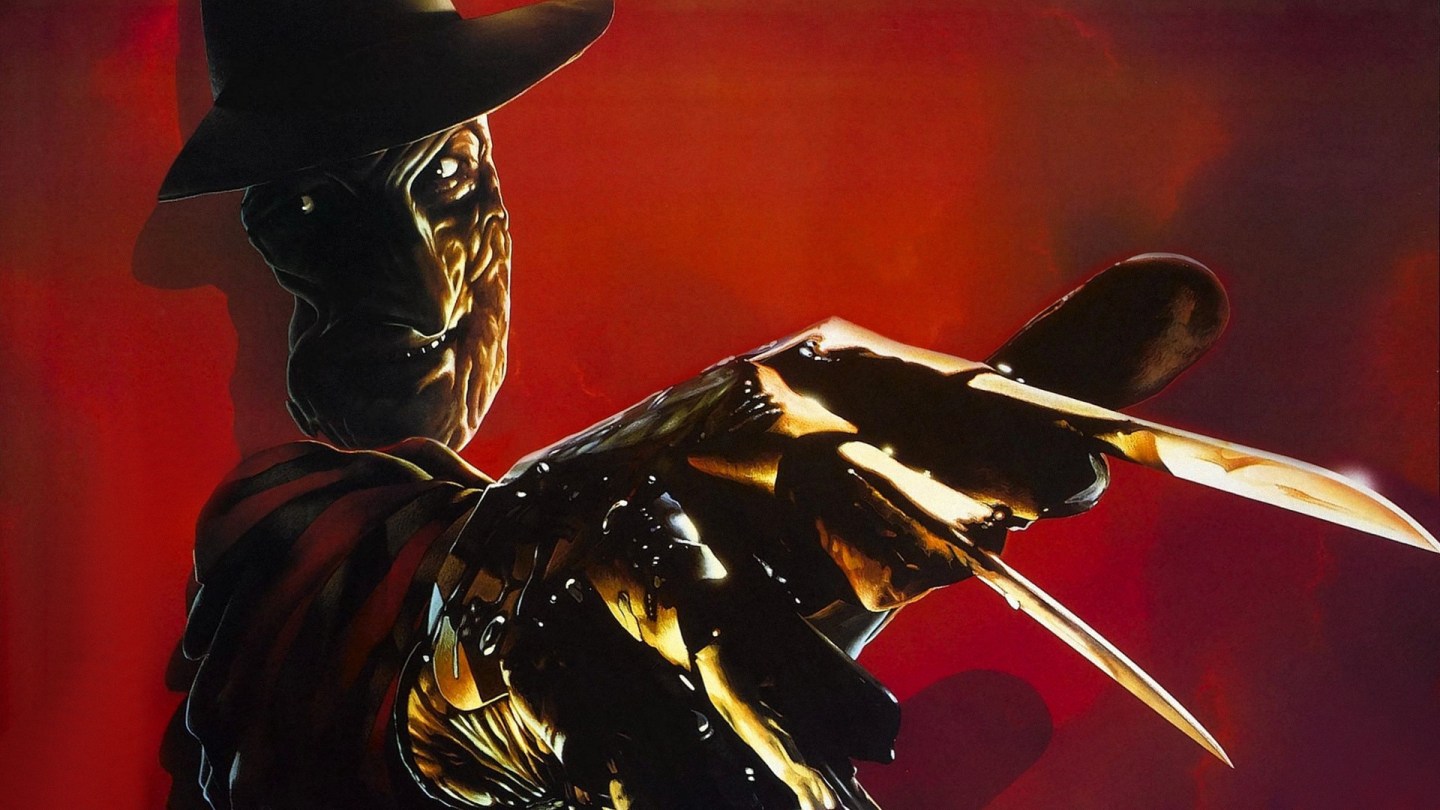
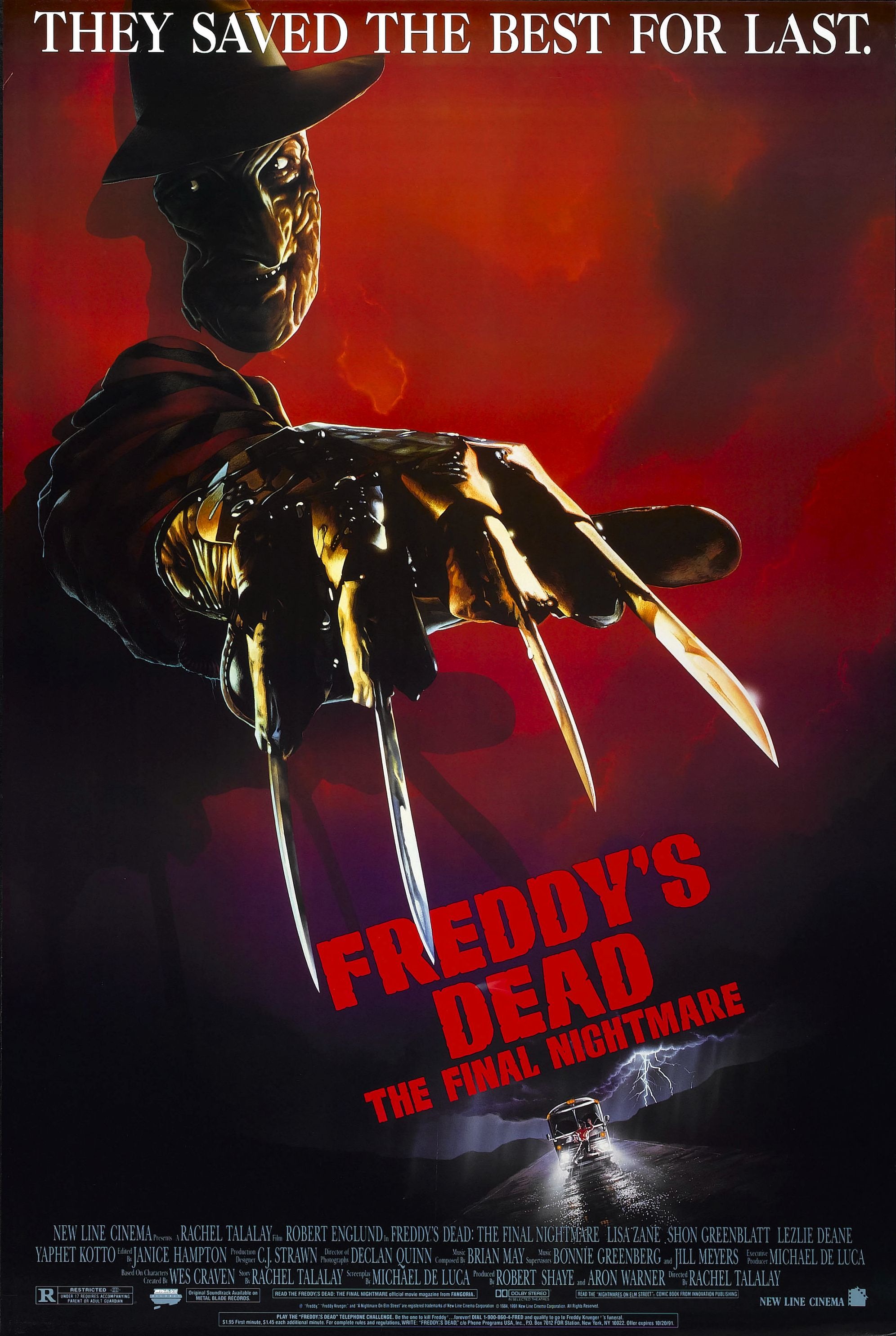
It’s Goodnight Freddy as Robert Englund’s facetious franchise monster goes out with a 3-D whimper
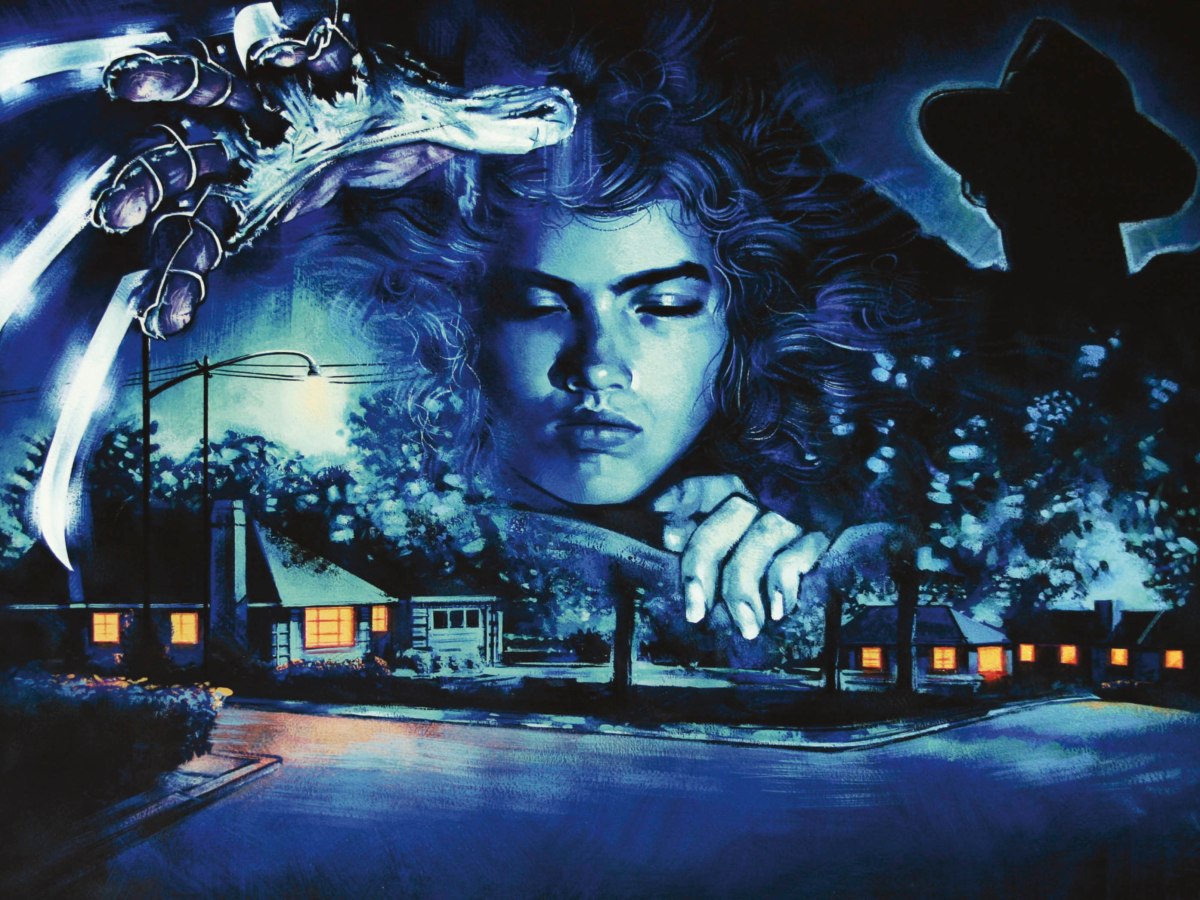
I have a real love-hate relationship with Fred Krueger. The original A Nightmare on Elm Street, an indie phenomenon that courted masterpiece territory until a spotty final act and a confusing, sequel-setting twist, remains one of my favourite horror movies, and was certainly a contender for the finest of the 80s. It didn’t have the pedigree of something like The Shining, but it introduced us to a once in a lifetime concept that was exploited ad nauseum for the rest of the decade, as well as a truly terrifying and memorable horror antagonist who would become one of the genre’s great icons. It also benefitted from one of the most affecting and befitting scores of the era, a heroine who put the majority of her final girl compatriots to shame, and the keen wit and intelligence of former professor turned filmmaker Wes Craven, who brought the whole concept so authentically to life, taking great care in the details and delineations that distinguish dreams from reality. Compared with the rest of the slasher’s oversaturated market, the movie had a strong identity and an even stronger aura.
The sequels didn’t fare so well. While 1985’s A Nightmare on Elm Street Part 2: Freddy’s Revenge retained a strong protagonist, Mark Patton’s sexually conflicted Jesse Walsh tapping into the AIDS-led ‘gay panic’ of the 80s, it ditched both Charles Bernstein’s original score and practically the whole dreamworld concept, replacing the latter with something closer to a possession story, which just seemed derivative and old hat compared with the freshness of the original only a year prior. They even ditched the one and only Robert Englund for a brief time, quickly re-hiring him after ample time with a replacement convinced them that they had made a gigantic, cost-cutting blunder (one of the reasons why the 2010 A Nightmare on Elm Street reboot fell so flat, despite a good go of it from replacement Jackie Earl Haley, was because Englund is simply irreplaceable). And if you think that the original A Nightmare on Elm Street dropped off during its finale, then Freddy’s Revenge will blow your mind with its inability to stay true to its internal logic, as things fall apart rather dramatically.
A Nightmare on Elm Street Part 3: The Dream Warriors, which re-embraced A Nightmare on Elm Street‘s visionary conceit in more elaborate ways, was seen as something of a return to form, becoming more of a cult favourite than the original for a generation of fans. The movie was bold and spectacular, retaining at least an element of darkness amid the comic book style adventures, but while the special effects are some of the best in the series, it definitely paved the way for everything that was bad about those later sequels, transforming Krueger, who retained a devilish sense of wit and tongue-in-cheek physical comedy from the beginning, into a horror devouring superstar ticket, the character flogging everything from imitation razor-fingered gloves to children’s pyjamas. Action director Renny Harlin’s A Nightmare on Elm Street Part 4: The Dream Master truly jumped the shark with a script that was written on the fly due to Writer’s Guild strike issues, the series becoming little more than a marketing-savvy exploit propped up by a series of striking practical effects set-pieces. Everything else, barring Robert Englund’s pizza-faced pin-up, became excruciatingly secondary.
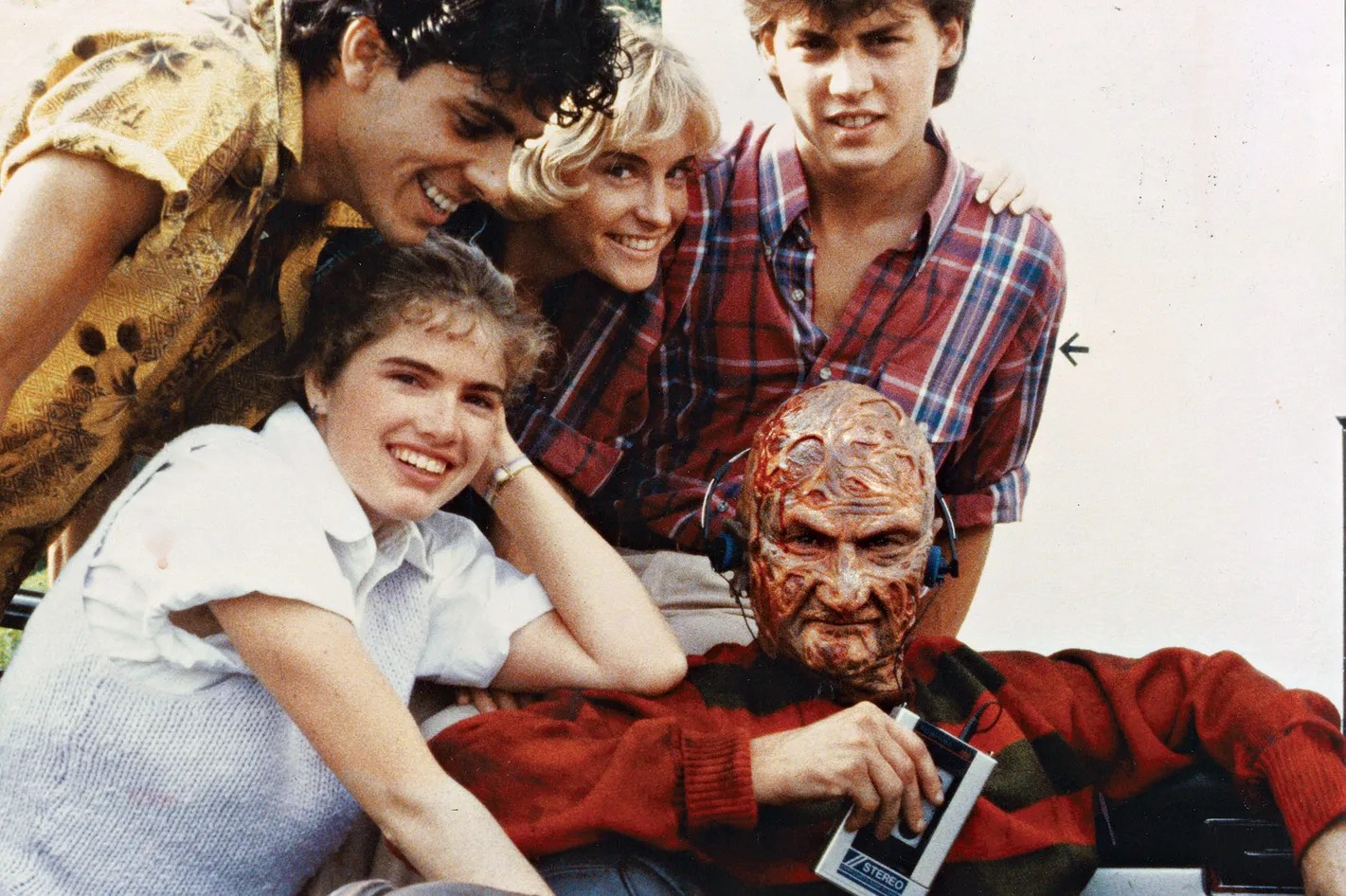
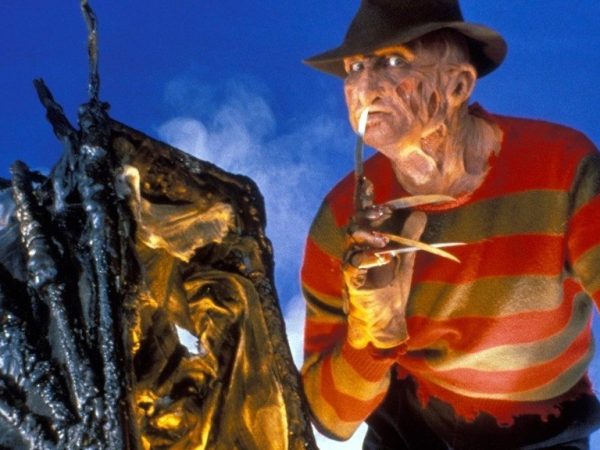
By the time Freddy’s Dead: The Final Friday made it into theatres, the franchise was long-dead as a genuine horror property. With his toned down make-up – obviously an attempt to make the character more palatable for kids – and dizzying descent into self-parody, Freddy was more a friendly mascot than a grungy, low-budget killer, the series embracing the realms of colourful fantasy. Losing track of exactly what it was, it was also weirdly unsure of itself, shamelessly courting the tween demographic while simultaneously dreaming up perverted plotlines with desperate attempts to further cash-in on a moribund concept. For many, the franchise had already become tiresome by Part 4, which was financially their most profitable until Freddy vs Jason a whole fifteen years later, but 1989’s A Nightmare on Elm Street 5: The Dream Child took everything that was wrong with the series and turned the figurative blender up to ‘putrefy’. Even as a fully-fledged, eight-year old Freddy fanatic, I was somewhat underwhelmed by the prospect of a sixth instalment, and I know I wasn’t the only one.
Kung fu THIS, bitch!
Freddy Krueger
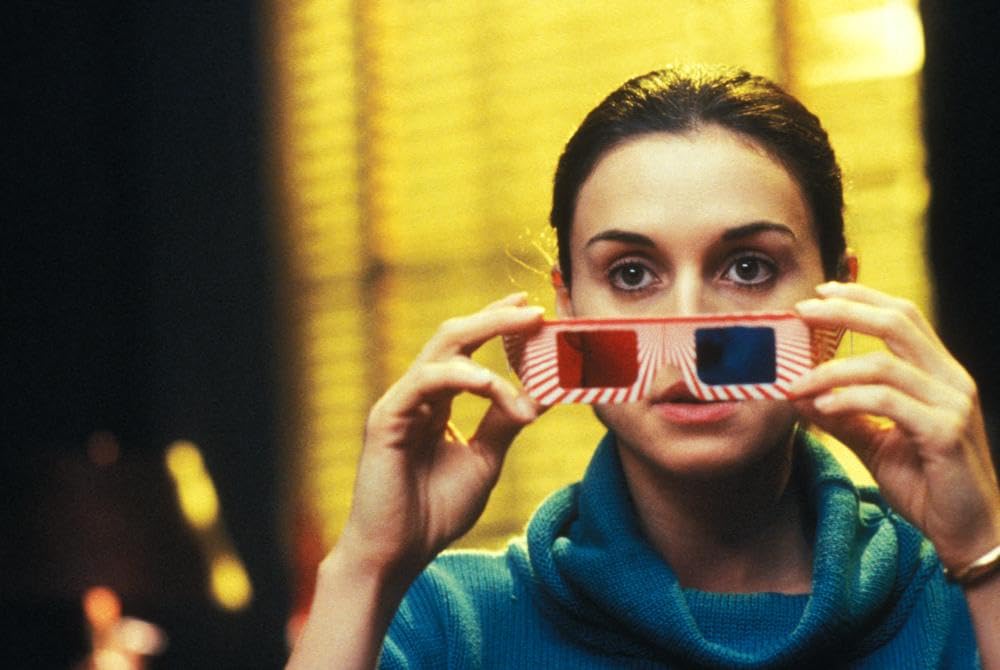
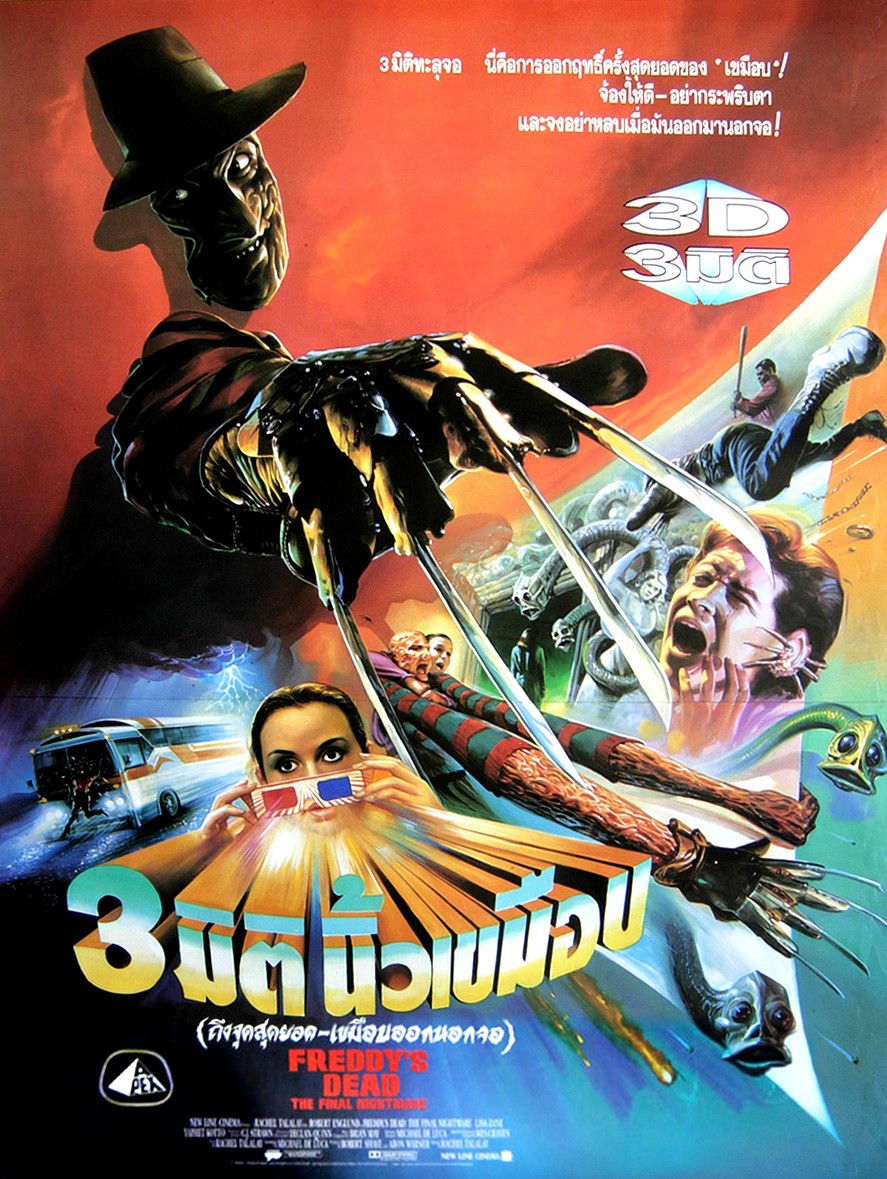
The Nightmare series was in desperate need of a quick-fix if New Line Cinema were to squeeze one final payday out of their golden ticket, and where did producers turn when the chips are down? 3-D, of course! If the 80s had confirmed anything, it was that 3-D was never the attraction that studios had hoped for, at least in the long term. In 1983, Paramount went down a similar route with their own faltering horror attraction, Jason Voorhees. Jason was part of a short-lived 3-D revival that died a quick and ignominious death, though it did pay dividends for both Paramount and Universal Pictures, both Friday the 13th 3-D and Jaws 3-D squeezing considerable sums out of their respective franchises, both of which were already running out of steam conceptually, though not half as much as the A Nightmare on Elm Street series by 1991. Paramount were already disappointed with Jason’s first outing as a marquee attraction. Friday the 13th Part II, which though managing close to 20 times its $1,250,000 budget, could not compete with Friday the 13th‘s near $60,000,000 gross on a budget of only $550,000. It’s not surprising given the original, a prime example of eureka marketing and razor-sharp timing that was one of the most successful indie films in history up to that point, essentially genericised the soon-to-be labelled slasher. Not even peak Freddy could compete with that. Other horror franchise’s, like Amityville, were put on the shelf thanks to their reliance on 3-D, the whole fad disappearing almost overnight, thanks in large part to its costly, time-consuming processes, but also because in reality it was all a bit naff and not worth the effort on both sides.
Producers never learn it seems. Though Robert Shaye was already aware that the series had run its course and served its purpose in terms of New Line Cinema’s financial security, instead looking to concentrate on other franchises such as Critters and The Teenage Mutant Ninja Turtles, he still wanted his most famous creation to go out with a bang rather than a whimper, and there’s always the motivation that they’ll get the technology right this time, but the gimmick proved nothing but a hindrance to those involved with both the technical and creative sides of Freddy’s Dead: The Final Nightmare. Director Racheal Talalay, who had been involved with the series for years as a producer, even went on record suggesting that the whole 3-D debacle directly and negatively impacted the movie’s focus on story, which can be confusing throughout, often bordering on the non-existent amid so much chaotic imagery. The processes of 3-D, which had proven a massive problem during both its 1950s and 1980s wave, was still a hugely problematic experience thanks to budgetary issues relating to specialised cameras and synchronised projection techniques. The fact that the whole 3-D experience was confined to only the last fifteen minutes proved a disappointment rather than something to look forward to. The process also didn’t translate to home video very well, which was where most of the Krueger character’s early 90s demographic, namely kids who couldn’t get into theatres, would have seen the movie.
As lousy and as pointless as Freddy’s Dead‘s 3-D debacle seems in hindsight, the problems with the final instalment in the original series are numerous. Many cite Freddy’s Dead as the lowest point in the series, and understandably so for the most part, but the concept was already falling apart at the seams as both credible horror and pop culture humour by 1991, and much of what you see was forced upon the director by everything that went before. The original A Nightmare on Elm Street, Wes Craven’s meta reboot New Nightmare, and to a slightly lesser extent A Nightmare on Elm Street 3: The Dream Warriors not withstanding, the series had always struggled with its commercial identity, be that Part 2’s homoerotic subtext and ditching of the original concept, Part 4’s MTV-inspired commercial chicanery or Part 5’s distressingly uneven tone. Once Freddy took off as a commercial phenomenon, there was a constant battle between the more gruesome, immoral attributes that the character was built on and how to maximise profits by targeting younger demographics. By the time Freddy’s Dead hit theatres, it was all so chaotic and muddled that the thrill of practical effects was no longer enough to paper over the cracks. Despite Robert Englund’s ceaseless enthusiasm for the role and preference for Freddy’s carnival clown incarnation, the joke had worn painfully thin.
Director Talalay is well aware of the criticism that the film receives, but also positive about Freddy’s Dead in its ability to hold up almost four decades after its release. It also became clear that this was very much a team effort, with a lot of the decisions understandably left to the movie’s star and producer. “Michael De Luca wrote a very, very funny script… a very pop culture oriented script for the time, which works and sometimes feels dated and doesn’t work or works really well,” Talalay would say. “In terms of Freddy, there was a lot of conversations with Robert (Shaye) in terms of direction, and where he wanted to go, because you have to trust the master. So Robert Shaye had a view line, Robert Englund, the two Roberts, were the masters of where to go with it… I think I am a little bit hurt and damaged by the sort of accusations that are made that I made ‘the girl version’ of the film. And ruined horror films. That’s a very classic internet hate thing that I should not worry about. But I do think that the film stands up. I do think there should be more appreciation for the script that Michael De Luca wrote, for the topics that he took on within it, and less accusations of it just being too funny.”
It’s extremely naïve and smallminded to dump the blame for Freddy’s Dead solely in the laps of the writer and director, but such a cherished franchise will always harbour strong opinions, and Freddy’s Dead is an opinion magnet. As standalone elements, the slapstick, hyper-referential comedy and ultra dark themes might have worked better, but as a whole it’s all just a little difficult to digest. The previous instalment, The Dream Child, though nailing the fantasy imagery, also wrestled with the balance between dark and light, between serving older fans of the series and the equally enamoured tween and even preteen demographics who helped transform the character into a supreme marketing machine. In many ways Freddy’s Dead is merely a necessary extension of the character forged in Harlin’s The Dream Master and exacerbated by The Dream Child, an amalgamation of all that transpired previously. All of this results in a confused mess that reveals just how far Krueger had strayed from his horror roots, and how little gas was left in the tank. In reality, there was no such thing as a triumphant ending to the Elm Street series in 1991. It was merely the inevitable burial of a moribund concept that had hopped aboard the commercial gravy train and careened headlong into the proverbial canyon.
The plot to Freddy’s Dead, at this late stage in the series, is fairly promising. Set ‘ten years in the future’, Krueger has laid waste to almost the entire child population in Springwood. The only remaining survivor, the transparently named John Doe, wakes up outside the city limits thanks to an elaborate opening dream sequence – a gobsmackingly camp nod to The Wizard of Oz which sees Krueger riding a broomstick as a cackling witch – that lays out the movie’s fanciful intentions bare. Conveniently suffering from amnesia, John winds up in the care of Maggie Burroughs (Lisa Zane), a doctor at a shelter for troubled youth who plans a trip back to Springwood with the hope of restoring his memory. Luckily for Krueger, three of the shelter’s other residents smuggle aboard with the intention of running away to California, only to wind up in Freddy’s lap. That Zane and the rest of the outside world are unaware of the town’s unique history, or at the very least unconcerned by the consequences of visiting, is borderline contemptible.
There are some seriously dark themes in Freddy’s Dead that just don’t sit right amid so much comical hokum. Freddy’s victims, who are both notably fewer and less engaging, have all suffered from physical and emotional abuse. Wealthy stoner and early 90s grunge stereotype, Spencer Lewis (Breckin Mayer of Clueless and Robot Chicken fame), struggling under the strict rule of his conformist father, is the least offensive of the three within the context of the movie’s confusing tone, aptly falling victim to the most tepid, poorly executed and commercially motivated death sequence in the series (Power Glove anyone?), but his two compadres aren’t so lucky. The deaf in one ear Carlos was subjected to horrific physical abuse at the hands of his mother, and even worse, tough girl Tracy was sexually abused by her father. In a played straight, oppressively bleak drama, all three would have been the perfect psychological fodder for a monster of Krueger’s tastes, but with a villain who borders on a Punch and Judy act, it all seems rather tasteless.
I’m a huge fan of Robert Englund as both an actor and as a larger than life personality, and the original Fred Krueger, a truly manipulative and nasty creation with a crude, sardonic wit to match his innate sexual cruelty, remains one of the most fascinating characters in all of horror. But, despite feeling differently at the time of their release, I’ve really come to resent those later instalments. I have issues, to varying degrees, with the first three instalments, but they all proved enjoyable for different reasons. Beyond that I barely raised a smile, was not scared for a single second, and to be honest I struggled to get through them. Englund’s favourite instalment was the one that changed it all, Renny Harlin’s ‘superhero’ horror The Dream Master, and he’s gone on record many times stating that he prefers Freddy’s sillier incarnation, but I’m just not buying it. Beyond nostalgia and the immediate thrill of some often marvellous practical effects, we’re dealing with some pretty lacklustre movies here.
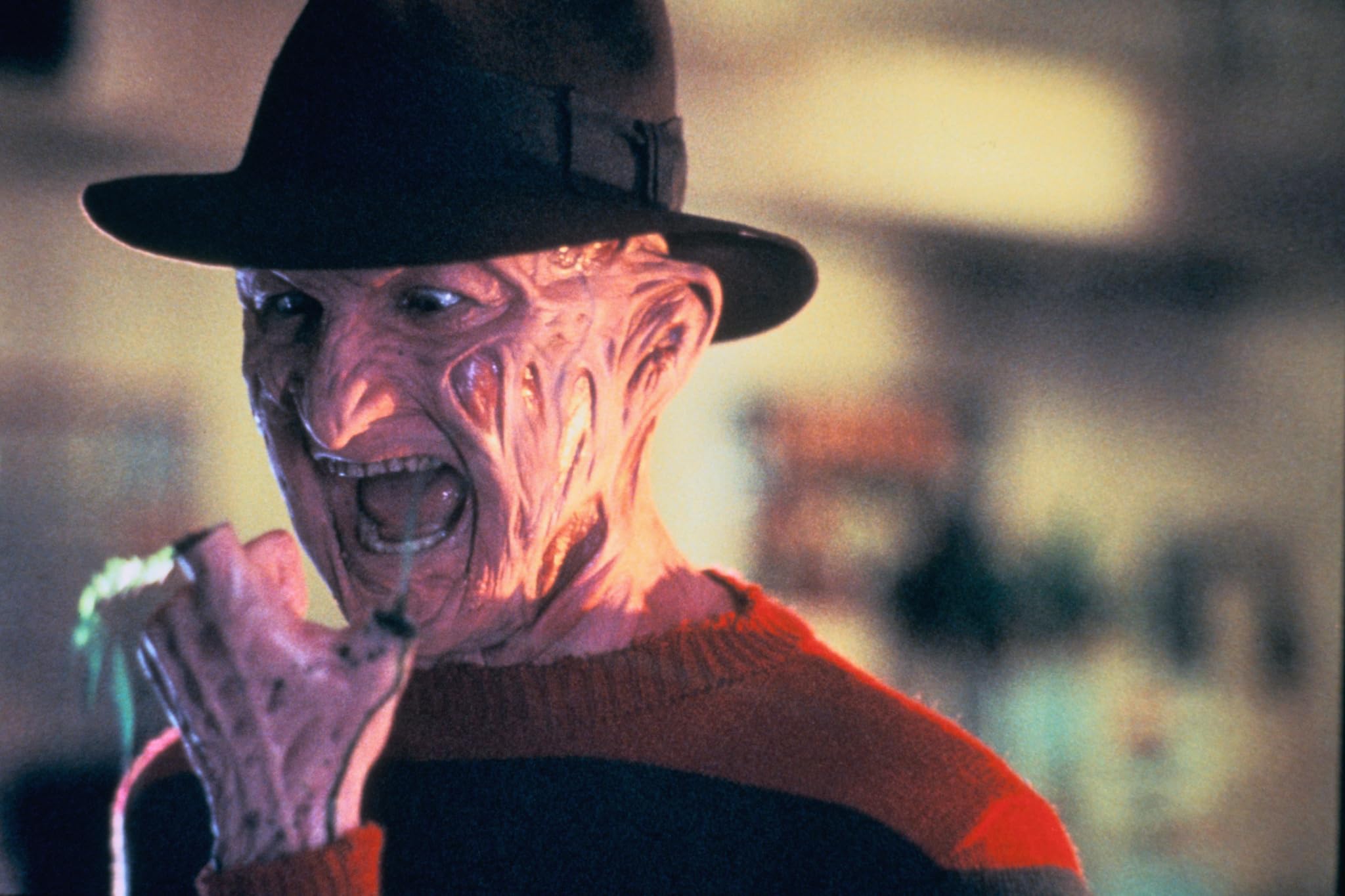
When not mired in convoluted backstories and emotional drudgery, the comedy and pop cultural references slap you in the face like a ten pound fish of immensely stinky proportions. It worked better in The Dream Master, because despite that film’s descent into Freddy formula, the practical effects set-pieces that the series would come to rely on were bigger, bolder and superbly executed for the most part. They also, however tenuously, maintained an element of sadistic horror. Of the three teen victims in Freddy’s Dead, only Carlos’ exploding head set-piece, the result of an amplified hearing aid and Freddy’s devious hijinks, retains even a semblance of the old magic. Spencer’s death by video game is totally at odds with any movie that is even remotely attached to the horror genre. It wasn’t a shameless plug for Nintendo, who actually denied New Line Cinema’s request to feature the struggling console accessory, only for them to defy the company and use it anyway, but it’s a clear nod to the Krueger character’s younger zealots, and an absolute killer for the property as bona fide horror. The remaining death, that of John Doe, is a straight-up Looney Tunes homage with Krueger as a successful Wile e Coyote. It’s well accomplished but ludicrous and hammy to the point of derision.
As much as it pains me to say it, even Robert Englund, the man who carried the franchise on his back through thick and thin and rarely faltered, regardless of the material, is beyond annoying at times, overcome with the girlish glee of a once master prankster high on success but short on fresh material. The witch on a broomstick and Looney Tunes gags are eye-rollingly stupid, but hardly his fault. The same cannot be said for the infamous Power Glove scene, or the earring aid explosion bit, which sees the actor surge into comical overdrive, so high on the rush of his own popularity that he quickly outstays his welcome before settling in for an encore. When Krueger runs his nails along a blackboard as a torture device for his audibly impaired victim, he quickly enters pantomime territory, prattling on like a stand-up act who doesn’t know when to quit. It’s a sad state of affairs at times.
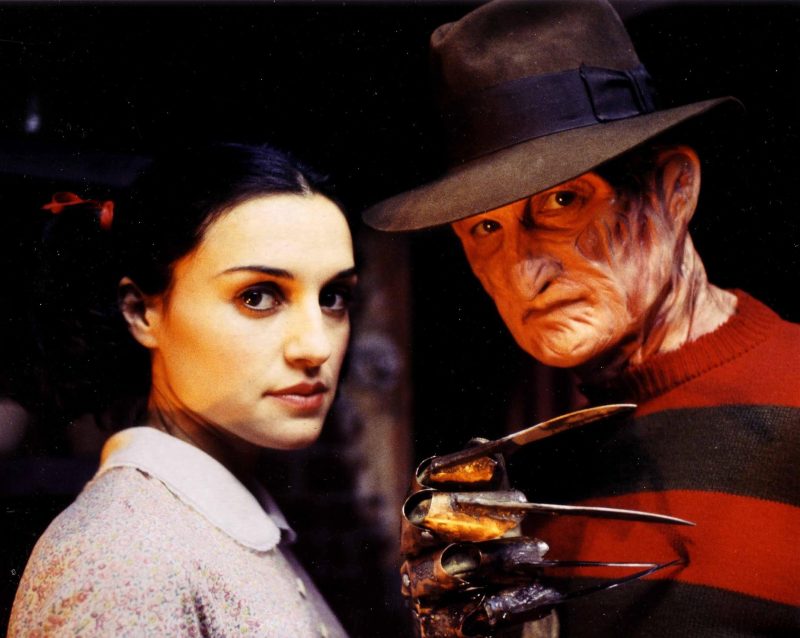
If all that wasn’t enough to sully Krueger and Englund’s reputations, the movie commits the biggest crime of all when it comes to supernatural killers of this variety: it concocts a convoluted backstory that tries to humanise Freddy when those details are best left to the imagination. This is particularly true for a grotesque child killer and implied paedophile, who works better as a mysterious entity that doesn’t bog audiences down in the darker details, especially when that character has long-since been rebranded as a glorified quipster. In Freddy’s Dead we not only discover that a pre-burnt Krueger was married in a past life, but he actually has a daughter living in the real world, one who, against all odds, just happens to stumble onto the film’s central narrative. Maggie Burroughs aka Katherine Krueger, who realises that Freddy can be killed if he is dragged into the real world, is highly sexualised in an incestuous way that can only be described as deeply uncomfortable in light of the movie’s tonal dissonance.
Of course, Freddy is painted as a victim too, teased as a child, with an abusive father who forged the monster that millions of kids would ironically grow to worship. He also dabbled in self-abuse as a teenager. There’s nothing wrong with this per se, most monsters are a product of nurture and environment, but it’s all so out of place in a popcorn horror that places such an emphasis on humour and celebrity-aided levity. Not even the popularised cynicism of early 90s grunge, which inevitably makes its presence known in the most generic way imaginable, can save the mood. To make matters worse, taking its cue from The Dream Child, Krueger’s makeup and general appearance has been further softened to appeal to younger fans of the series. Sometimes he looks like a toothless old hag brimming with cartoonish bravado. I mean, what exactly are they peddling here?
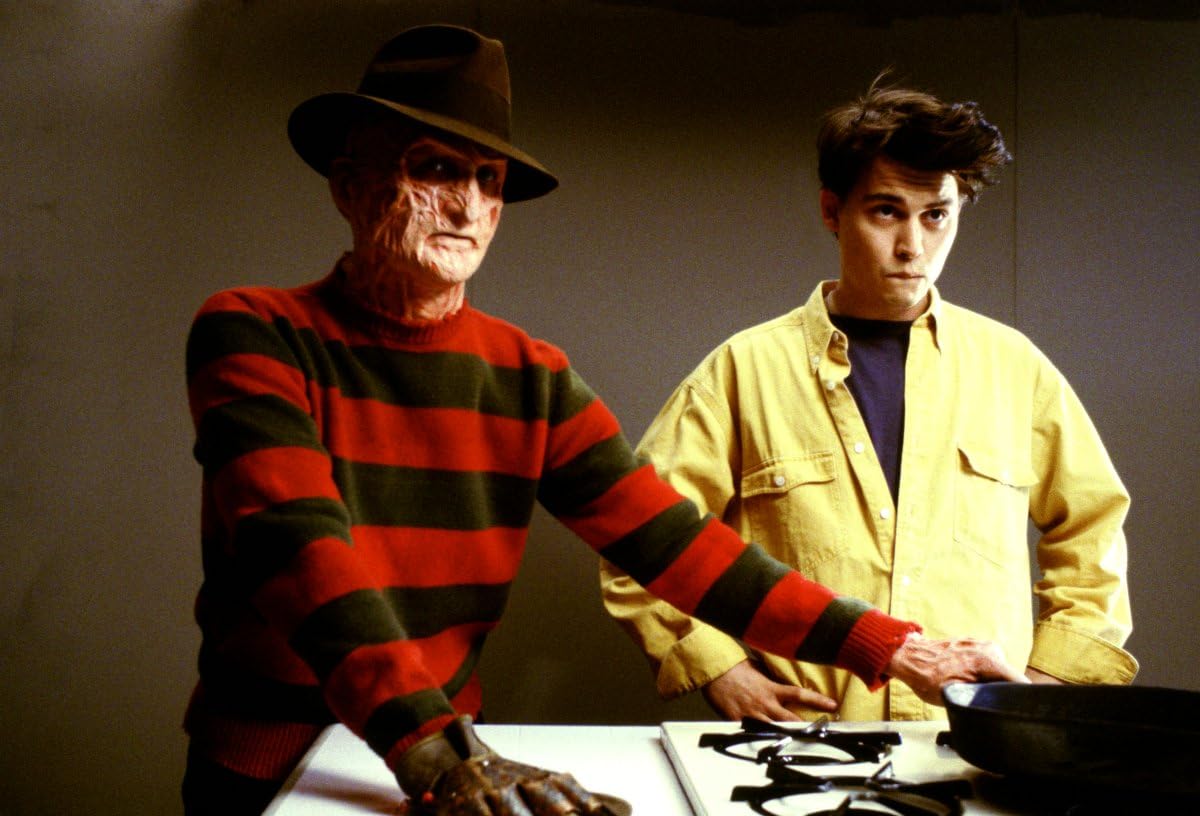
Then there’s the whole celebrity cameo side of Freddy’s Dead. Johnny Depp makes a meta return to the series, which though completely unnecessary, at least makes a modicum of canonical sense due to the actor previously starring as doomed Nancy crush Glenn in the original A Nightmare on Elm Street, but the weird, borderline morbid appearance of volatile Hollywood couple Tom Arnold and Roseanne Barr is nonsensical, aimless, completely devoid of wit and humour, and severely dated, even for 1991. Krueger was no stranger to celebrity before Freddy’s Dead, other, more logical cameos and rock star tie-ins becoming the norm during Krueger’s commercial apotheosis, but by this point it all seems just a little desperate and tacked-on, like a stale sitcom that has come to rely on celebrity endorsement rather than using it sparingly and effectively.
Freddy’s dead.
Maggie Burroughs
According to Talalay, executive meddling may have played a part in the disappointing theatrical cut of Freddy’s Dead. For starters, approximately forty-seven minutes of footage was removed from the final print, now available in the 104-minute workprint, which included sequences that were either significantly shortened or deleted in their entirety as a way to get to Freddy’s 3-D demise more quickly. When you compare the two, the theatrical cut does remove some of the darker moments, but in all honesty, it’s not nearly enough to repair the movie’s flaws, and 90 minutes of Freddy’s Dead is more than enough for this viewer. Talalay also referred to an alternate ending in which Freddy’s dream demons are passed on to inhabit a new body, though the version was never screened to a test audience and has now been lost in its entirety, with only screenshots and part of a script left to prove its existence.
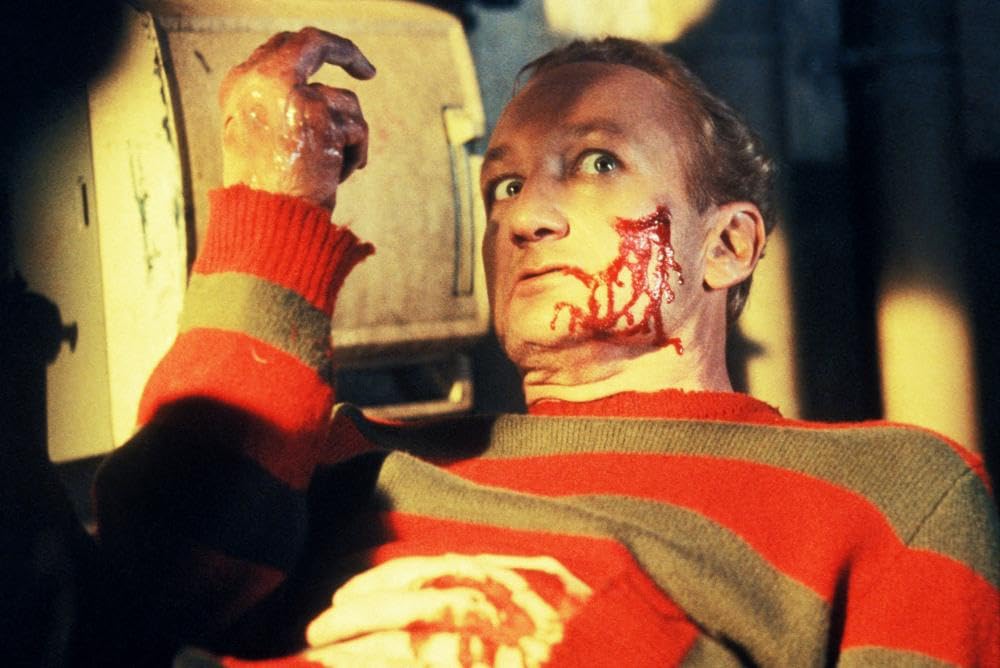
“We did film the ending, per the script,” Talalay explained. “So this coda basically had the demons from Freddy going into another boy’s body. The cycle perpetuates, very horror film sequel. Actually we cut the sequence out of the film almost immediately so we never even tested it. It was pretty much agreed universally that you can’t call the film ‘Freddy’s Dead: The Final Nightmare’ and advertise that it’s the final nightmare and then have a coda like that. Pretty much everyone agreed it was false advertising and it wasn’t a good look for what was supposed to be the final nightmare.”
Freddy’s Dead does have its fans. Talalay, who would go on to direct cult science-fiction film and British post-apocalyptic comic book adaptation Tank Girl, has already revealed that for every internet snark pointing the finger and criticising her handling of the property, there are fans who are happy to accept the movie for what it is, many of whom actually citing Freddy’s Dead as one of their favourites in the series. Call me cynical, but nostalgia has to play a huge part with this subset of diehards, because objectively speaking, at least from someone who prefers Krueger’s darker, meaner incarnation, it’s hard to be too complimentary about Freddy’s final foray before the inevitable reboot. Craven worked wonders in re-establishing Krueger’s fearsome aura with New Nightmare, but the fact that he replaced the fictional Krueger with a different, though physically identical meta demon speaks volumes about the dramatic descent of the series as something that could be taken even remotely seriously.
I’m not blaming anyone directly. Movies of this nature are a team effort that are often dictated by outside commercial forces, and if we’re being honest the series already had more than one foot in grave by the time Talalay and De Luca were allowed the privilege of fronting one of the most famous horror franchises of the 20th century. And despite an almost universal critical backlash, it remains a privilage, because most would sell their own mother to get their hands on a property of this magnitude. It’s a once in a lifetime opportunity. “Everything I know about filmmaking I learned on A Nightmare on Elm Street because they were so unbelievably challenging; because they were so inventive.” Talalay would recall. “It’s the most creative environment you can possibly be put in, in the most challenging way, not enough money, so how can you turn down this sort of learning curve, going from being an accountant to a producer, through to director, on a franchise that was so fantastic, and had such a fanbase, immediately.”
Director: Rachel Talalay
Screenplay: Michael De Luca
Cinematography: Declan Quinn
Music: Brian May
Editing: Janice Hampton







 vhsrevival.com
Freddy’s Dead, this final nightmare was indeed a nightmare! Oh dear, after such a strong start it’s strange to see how the franchise became so far removed from Craven’s brilliant original. My favourite in this series is still Dream Warriors. I can’t remember much about Freddy’s Dead tbh, aside from the opening with Freddy on a broomstick as a witch – which was quite inspired I think – this was the death knell for the series. I’m kinda glad we did get Freddy Vs Jason eventually though, I like to think of that as the last hurrah for both of those iconic horror franchises – at least it was watchable and fun to see them slug it out. Great piece and look back at the movies, always enjoy these retrospectives 🙂
LikeLike
Cheers, Paul.
I hadn’t seen this one for a while, and though it’s visually interesting on occasion, it’s even less watchable than I remember. In fact, it’s painful seeing what Krueger and Englund had become by the his point.
FvsJ may be Englund’s best performance & the film is much more enjoyable than this one.
May I suggest you revisit this one, if only for the novelty of seeing how far things had plummeted.
To be fair, nothing could have saved it. It was beyond a lost cause. Craven was even forced to re-imagine the character for New Nightmare, which speaks volumes.
LikeLiked by 1 person
KWYM. It was an abysmal effort and a sorry way to see the franchise “end”. I’ve not seen it in ages, so guess that’s why the broomstick scene is the only thing I really remember about it – that and the terrible 3D gimmick LOL. I’ve rewatched the first three films recently actually, so will no doubt get around to this one eventually. I don’t often watch horror film, but when I do I tend to binge on a franchise LOL! I loved the New Nightmare though, that one was like a love letter to the series and a precursor for what Craven would go on to do with Scream. FvJ is another favourite of mine, Englund was fantastic in that. Shame they never did a rematch movie. When it comes to Freddy Kruger perhaps it’s best to just reflect on the good bits we had, especially given the dreadful reboot they did which shows that some nightmares, are better left undreamt of. 🙂
LikeLike
So true. For such a long, iconic franchise, the peaks are fewer than the valleys. Now the whole Friday the 13th rights saga is over, maybe they’ll do a rematch. You’d think they’d have to reboot each series first though. It’s been so long, modern horror fans might not remember.
LikeLiked by 1 person
They could indeed. The timing would be perfect for a rematch and revival. Even though Robert Englund has stepped back from the role, they could potentially use CGI like in Rogue One and he could still voice Freddy? I guess they could recast, but after the dire reboot I also kinda wish they don’t. I just can’t imagine Freddy without Robert Englund in some capacity. If they did pull it off though it could potentially lead to a revival for both franchises – or new interest the the old films at least.
LikeLiked by 1 person
I’d love a proper reboot of both franchises. With Englund retiring I’d be more willing to accept an alternative to him as Freddy.
LikeLike