


Director: Mark Goldblatt
18 | 1hr 26min | Action, Comedy, Horror
In the zany world of self-aware action movies, the late Treat Williams was a bona fide MVP. What made him so special was the fact that absolutely none of it was accidental. He always seemed to put his heart and soul into it. He completely got the joke. Films of the ‘so bad they’re good’ variety, even those made by design, can usually count on a lunkheaded protagonist and a plethora of aleatory moments that somehow manage to reach the heady heights of bad movie folklore. Even the likes of Arnold Schwarzenegger, for years the hottest action star in Hollywood, was capable of accidental moments of laughable clunkiness that eclipsed even his drollest one-liners (see the gloriously silly Commando). Conversely, Williams was a fine actor and veteran of the stage; an author, writer, and aviator who starred in such classics as Sidney Lumet’s Prince of the City, Steven Spielberg’s 1941 and Sergio Leoni’s epic crime drama Once Upon a Time in America, but like a world class ventriloquist act he could bury his tongue so far in his cheek that pure deadpan magic ensued, a spell that was impossible to shake.
Perhaps his most memorable B-movie run was as ex-mercenary-come-substitute teacher Karl Thomasson, the dry-as-a-bone protagonist of a series of action sequels to 1996’s The Substitute. Some of you will at least be familiar with the original movie, a Tom Berenger vigilante vehicle that tapped into the wave of Dangerous Minds clones pouring out of the mid 1990s. The film was a hoot, propelled by over the top action, dubious Death Wish politics and moments of sheer stupidity that tickled the funny bone like an abandoned feather duster housing a flea circus. Tom Berenger was also perfect casting as original lead, Jonathan Shale, but when the series was reduced to direct-to-DVD territory and Berenger inevitably fled the coop, Williams was there to pick up the pieces with 1998’s The Substitute 2: School’s Out, 1999’s The Substitute 3: Winner Takes All and 2001’s The Substitute: Failure Is Not an Option, which were arguably even more hilarious, the equivalent of what Cannon Films did to Charles Bronson’s Death Wish series. Inevitably, Williams was the key ingredient that kept the series chugging along in the commercial doldrums of B-movie madness.
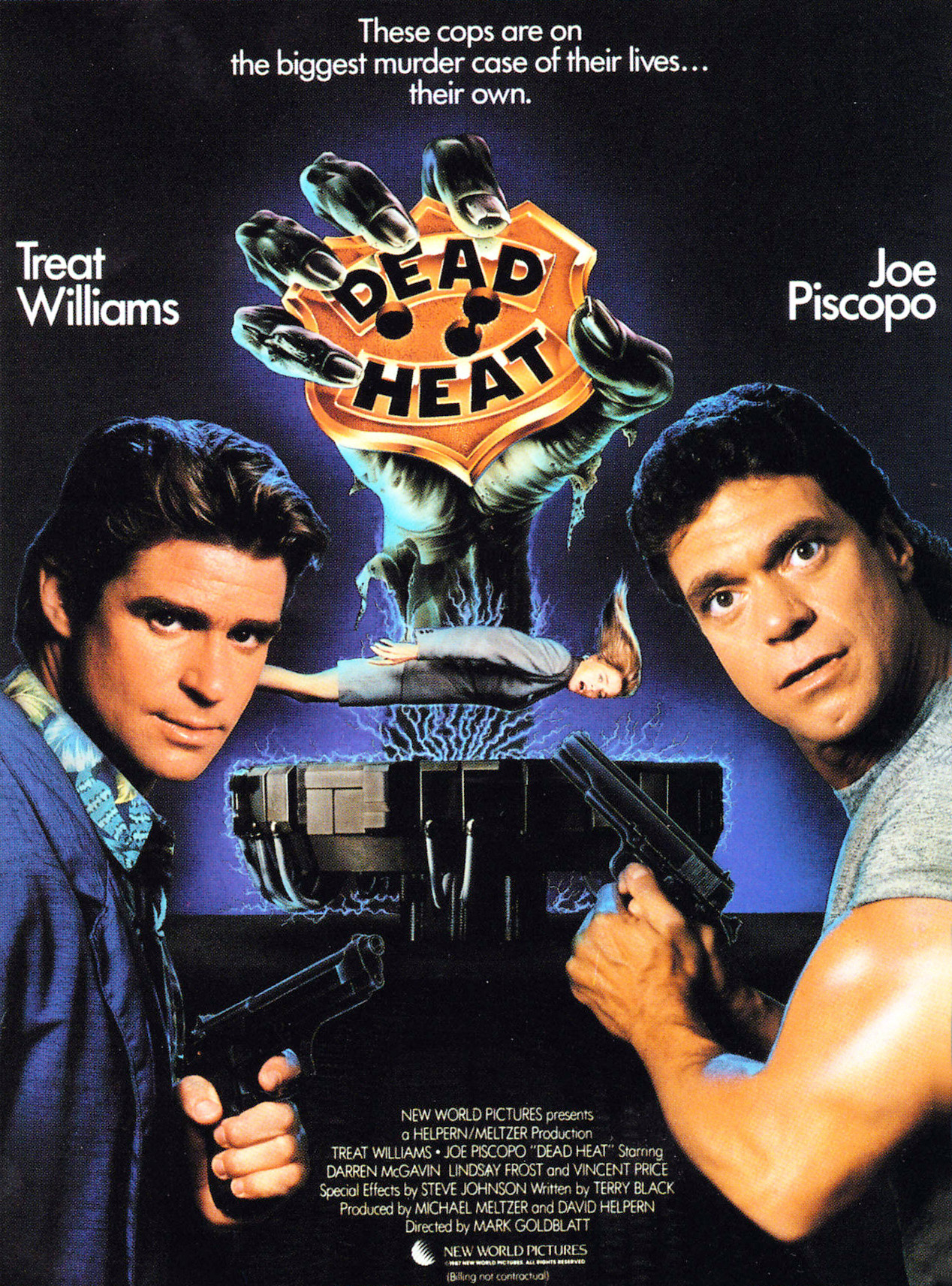
My first introduction to Williams’ self-referential powers came long before I was even aware of the actor’s existence. It was in one of those obscure, late-night films that we sometimes happen upon by pure chance, typically because TV stations stock up on such oddities to reduce outgoings. Pure chance is the best way to discover such gems because when you go in blind you’re just not expecting the madness they’re about to serve-up, particularly when the film in question masquerades as something wholly formulaic and predictable with the sole intention of flipping us the middle finger. In the case of the Academy Award nominated Mark Goldblatt’s deliciously bizarre, buddy cop horror mash Dead Heat, that middle finger emerges from the grave of zombie movies past, lovingly sending up the traditions of a plethora of cinema’s most escapist genres.
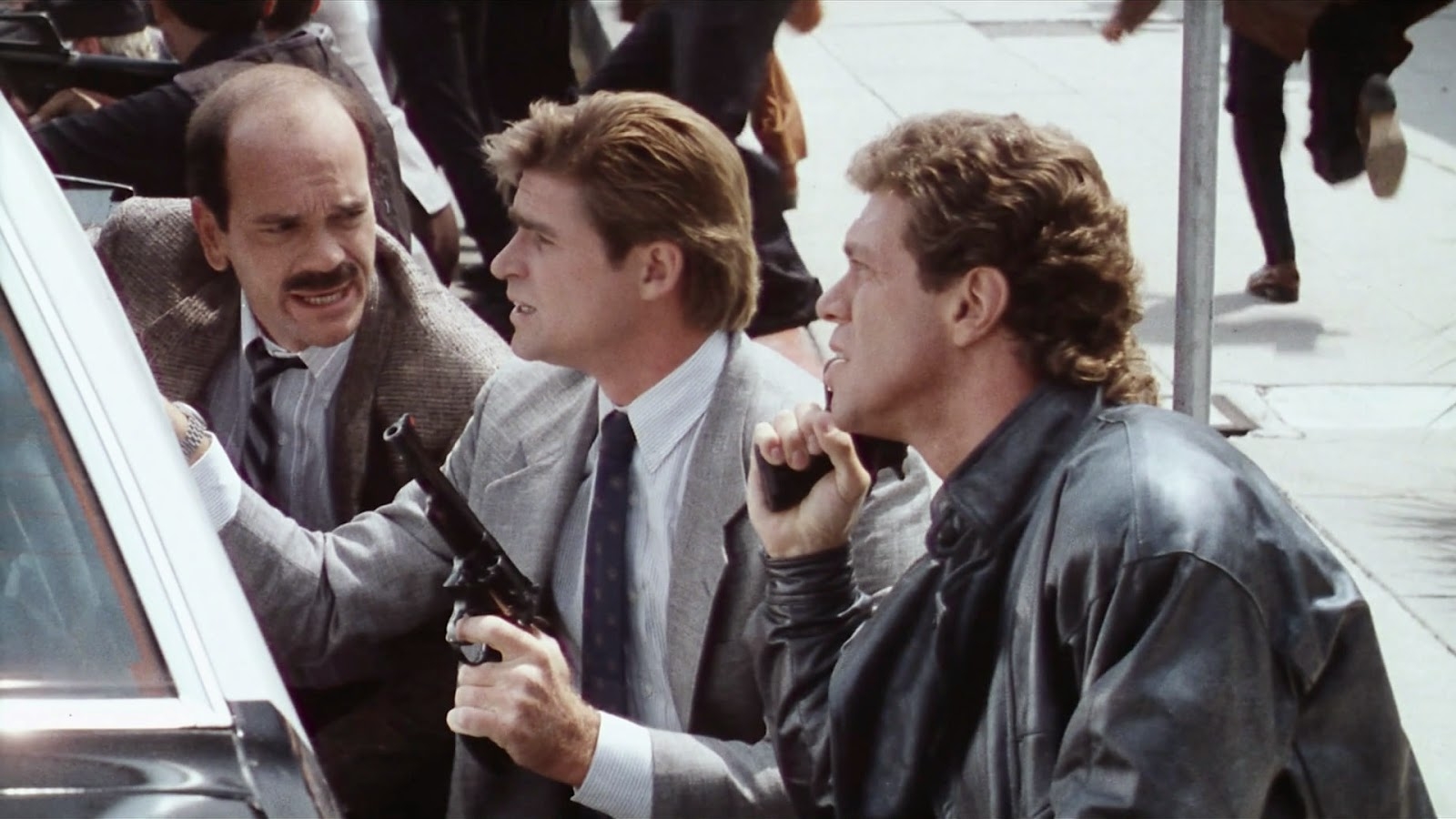
As genre crossovers go, Dead Heat is about as bold and as ridiculous as they come. It begins as what appears to be a a bog-standard buddy cop derivative a year after Richard Donner’s superlative Lethal Weapon perfected the formula, leading to a slew of copycat efforts that tried to capture the Riggs and Murtaugh magic as the franchise blew-up commercially. By the early 1990s buddy cop movies were ten to a penny, all kinds of bizarre pairings coming to fruition as producers threw anything, everything and everyone at the wall in the hope that something would stick. That’s why we were allowed the dubious pleasure of Double Team‘s Van Damme/Dennis Rodman axis, the absurd pairing of Matthew Karedas and Mark Frazer in Amir Shervan’s excruciatingly absurd cult action movie Samurai Cop, and of course Dead Heat itself, which while not as commercially viable as a Van Damme vehicle or as comically inept as Samurai Cop, proved far more creative and in some ways more rewarding.
Perhaps unsurprisingly, Dead Heat was the brainchild of Lethal Weapon scribe Shane Black’s older brother Terry, who had been working on the concept, a homage to 1949’s classic film noir D.O.A, since 1985, taking the film’s basic plot about a fatally poisoned hero with hours to find his killer before his inevitable death and gradually adding action movie tropes, far-out sci-fi shenanigans and monstrous horror elements. His script, panned by mainstream critics who viewed the movie as “repulsive potpourri” with “one-note sophomoric humour”, was purchased by Helpern/Meltzer Productions in 1986 after Black won second prize in a national competition for student writers. So enamoured with the concept were producers that they were already planning for a sequel if Dead Heat, as they had predicted, wowed the box office. It didn’t, the film managing a paltry $3,588,626 on a budget of approximately $5,500,000, a significant loss for such a low-risk venture.
According to Black, the blame was hardly indicative of his own approach of tackling “terrors and inevitabilities” lightly in order to make them “a little more bearable”, the screenplay subjected to early re-writes that drastically altered the tone of key scenes and ditched others entirely, including a batshit dream sequence in which Williams, in the fast-composing realms of the walking dead, is given a surprise “death day” party, complete with balloons, cadaverous guests and a bikini-clad creature who bursts out of a celebratory cake. “I really liked that one,” Black recalled. “I even had a cameo bit. They told me it didn’t really advance the plot.” A shame, but there’s plenty of madness to go around in the movie’s theatrical cut.

Following a familiar bloodthirsty shootout with a gang of jewellery store thieves, Dead Heat quickly evolves into something else entirely, wryly taking a tried and tested formula and rubbing our faces in the punchline. On the surface the movie is as formulaic as they come, giving us a disgruntled ex-wife, an exasperated police captain, a fiendish villain who is shielded from suspicion while in cahoots with the Chinese mafia, and two polar opposites who have somehow found harmony. Williams’ Roger Mortis (a surname that is derived from the Latin word for death and almost sounds like rigor mortis) is the straight-edged detective with an acerbic bite, partner Doug Bigelow (Joe Piscopo) more of a randy meathead with a penchant for the reckless and lowbrow, but unlike those other movies, Dead Heat doesn’t present us with a Lethal Weapon style arc of evolving friendship out of a rubble of mismatched reluctancy. The two are already in-sync despite an obvious gulf in personality.
Of course, that wouldn’t make for much of a movie in itself, which is why some mindboggling supernatural forces are introduced to throw one hell of a spanner in the works, leading the two buddies on a time-strapped quest for justice that replaces D.O.A‘s poison angle with some classic, practical effects heavy zombie degeneration. Suspicions understandably arise when the gang of hoods who were gunned down in cold blood while attempting to flee with a cache of jewels suspiciously disappear from the morgue, and if you think this has anything to do with logical oversights or late-night bodysnatching, you’re clearly not ready for Dead Heat‘s inimitable brand of slapstick horror comedy. Not only are the corpses in question missing, the newly deceased have actually been dead before, undergoing full autopsies before rising up to head into the night.
According to Roger’s ex-wife and resident coroner Rebecca (Clare Kirkconnell), who has records to prove her theory, the returning undead are full of Sulfathiazole, an organosulfur compound which has been ordered in massive quantities by surreptitious corporation Dante Pharmaceuticals, and which may be a source of human reanimation, knowledge that she presumably acquired at a medical school for the criminally insane. Armed with the kind of radical suspicions that would have any cop committed to a mental asylum in a heartbeat, the two crime fighters begin snooping around Dante headquarters, leading to the kind of timebomb tragedy that threatens to separate our partners in crime fighting irrevocably.

Roger’s race against decomposition begins after he is killed in a decompression chamber and quickly brought back to life in the corporation’s sinister and not-too-subtly named resurrection machine, a contraption which, with no previous knowledge of its uses or functions, Rebecca manages to understand and operate in a matter of seconds. Awakening with a smile, Roger has never felt better. The only problem is he has no pulse. Nor does he bleed after accidentally severing his artery (despite the fact that he bleeds at every opportunity thereafter), a diagnosis that, those missing cadavers notwithstanding, is unprecedented in the medical profession.
Such developments lead the trio to deduce that Roger is still dead, and though undertaking no further research regarding a completely new scientific phenomena, Rebecca manages to further diagnose her former spouse, coldly informing him that he has approximately twelve hours until total decomposition, a time when his body will dissolve into a kind of organic stew. Unfazed by her groundless diagnosis and talk of a possible cure, detective Mortis is instead interested in using his final hours to nail whoever landed him in this mess, shrewdly (though hyper-conspicuously) using hooker grade lipstick to conceal his paling kisser while in search of the truth. First on his list is the surreptitious Randi James (Frost), the supposed daughter of Arthur P. Loudermilk, a recently deceased millionaire who had previously used the Dante research facility as his own personal plaything.
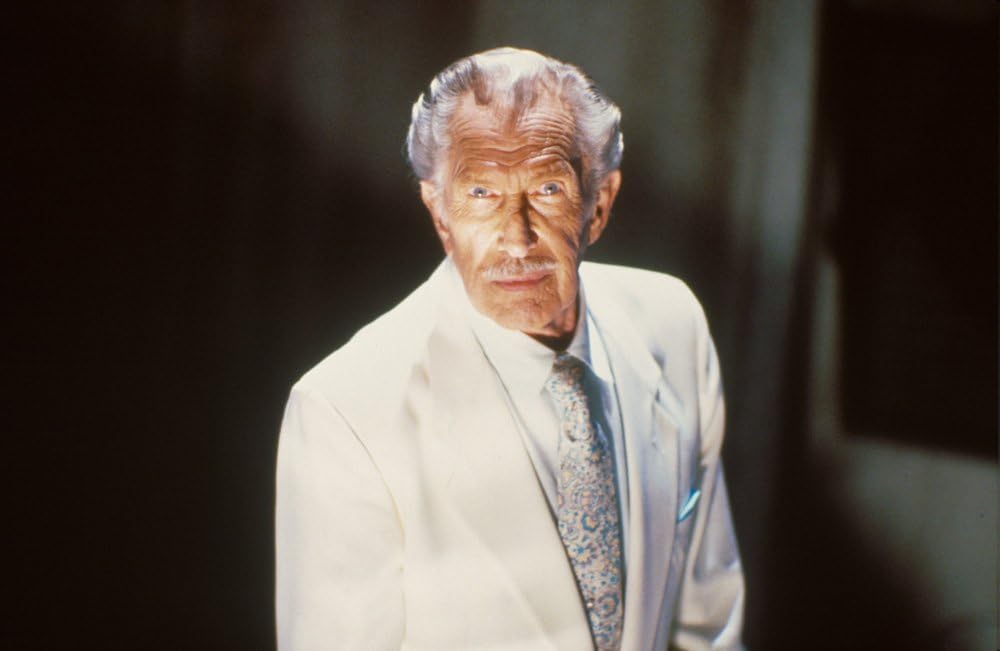
What unravels is an elaborate scandal funded by the reanimation of criminals who act as a lightning rod for Rebecca’s boss and head coroner Dr. Ernest McNab, who after using the resurrection machine to bring Loudermilk back from the dead, begins pitching the contraption’s diabolical powers to L.A.’s wealthy elite with the promise of eternal life. Crucially, Loudermilk is played by a deliciously hammy Vincent Price in one of his last performances before his death in October 1993, laying bare Dead Heat‘s golden age horror influences amid so much hyper-referential silliness. This is Frankenstein with cynical 80s humour and holster accessories, a joy for anyone fascinated with the history and tropes of genre films, though scenes featuring zombie hitmen, undead ducks and reanimated cow livers have to be commended for their originality. Well, sort of.
Ultimately, the key to any buddy cop movie, whichever form it may assume, is the chemistry and camaraderie of our lead players, and while Mel Gibson and Danny Glover were hardly quaking in their boots, in a completely off the wall way it all kind of falls into place. Piscopo is passable as Bigelow, projecting an endearing oafishness that is partially by design but largely down to his inexperience in the medium of film. Piscopo is a comedian most famous for being around for Saturday Night Live’s lowest ebb, a viewer backlash leading to a mass cull that only he and action innovator Eddie Murphy would survive. Unsurprisingly, his comedic star wouldn’t shine for too much longer, but his presence is largely welcome in a movie that excels at being exceedingly dumb.
Unsurprisingly, Williams is once again the movie’s MVP, embracing Dead Heat‘s distinctly B-movie formula with the same gusto he would a major motion picture. Surely a part of him was in it for the paycheque, but you never feel short-changed by a performance of exquisite dryness that both belies and embellishes the almost flat-out absurdity of a truly unique film. As an added bonus the actor even ditches the buttoned-down cop attire for a badass leather jacket and Uzi for the movie’s finale, going full-on Terminator as the realms of eternal zombiedom draw ever nearer. Unfortunately, the late actor will be back only in a re-run, but if you are yet to do so, check out Williams’ surprisingly brilliant B-movie catalogue. He may have had the acting chops for much more serious roles, but he is equally at home in the bargain basement haunts of bad movie madness.
Liar, Liar, Face on Fire
In an era of pre-CGI, practical effects excess, the zombie movie-inspired Dead Heat does not disappoint, embracing such moments with an overt silliness that underscores the film’s gloriously self-aware presentation.
After unexpectedly revealing that she too is a zombie who had been promised the wonders of eternal life, Loudermilk offspring Randi begins to wither and melt into a lip-dripping stew.
Wracked with guilt following her constant lies and misleading tactics, her decaying skull even manages to repent, unhindered by the fact that it possesses neither a tongue nor vocal chords (or even a brain for that matter).
Saturday Night Jive Turkey
One of the few scenes that received reluctant praise from critics who were largely unimpressed with Oscar nominated editor Goldblatt’s Dead Heat occurs at a Chinese mafia hideout brimming with reanimated produce.
One particularly priceless moment sees our two heroes, after pressing the Chinese mafia for details about their mass purchase of sulfathiazole, set upon by a whole host of dead animals, including fried ducks, split pigs and a giant, headless cow.
Not to worry! Bumbling musclehead Doug has a cunning plan: to drown the cow in A1 sauce.
Doug, it has no head.
Choice Dialogue
Attaching a duck head to a battery and marvelling at its quack concerto, detectives Mortis and Bigelow are left befuddled. What transpires is a pun so dumb it would fall flat rolling off Arnie’s tongue.
Roger Mortis: Zombie duck heads: what a concept!
Doug Bigelow: This could replace the whoopee cushion!
A zany treat which delights in its own silliness,
Edison Smithflips one off to the joyless bad movie cynics, offering a valuable lesson to those who are quick to condemn. Perhaps the greatest buddy cop/zombie crossover ever committed to celluloid, and almost certainly the only one.








 vhsrevival.com